The last forest walk of the year: a reflective nature ritual to reconnect before midnight
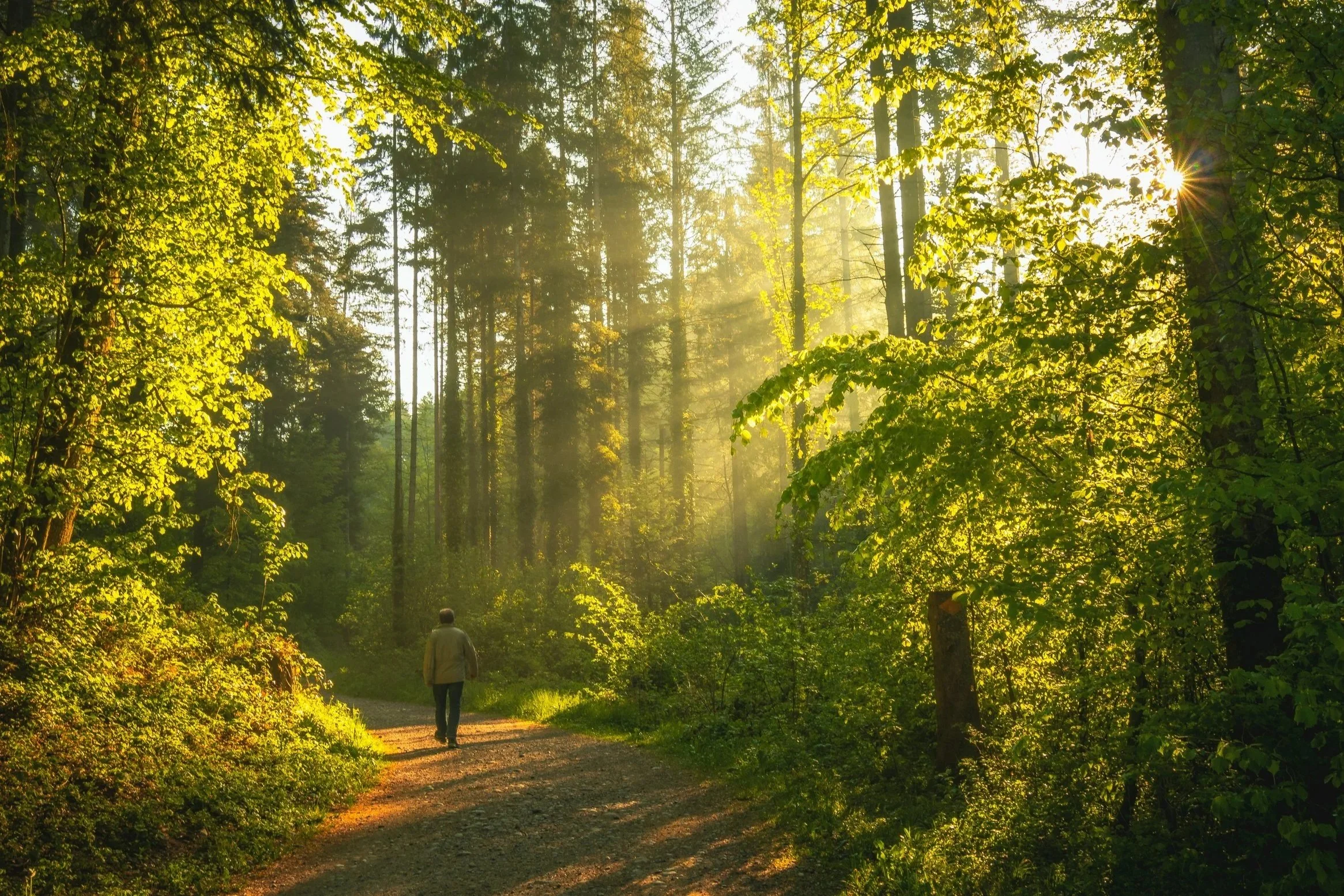
A solitary figure walking along a forest path as warm sunlight filters through tall trees, capturing a quiet moment of reflection and slowing down during a year-end walk in nature.
At the edge of the year
Evening gathers the last moments into its soft hands.
In the final hours before midnight, time loosens its grip. The air cools, the light drains from the sky, and even the breath seems to slow, as though it too is aware of a boundary approaching. The ground underfoot is damp, leaf-softened, carrying the cold without complaint. Each step presses into a surface that has been taking impressions all year and will take many more after this one is done.
You step into the forest without ceremony. No resolution announced, no intention spoken aloud. Just a walk, taken because the day allows it, because the hour feels slightly hollow, as if it needs filling with movement rather than noise. The path is familiar, or perhaps only familiar in the way trees often are — not known individually, but recognized as a presence, a density, a way of holding space.
At first, the mind keeps its usual pace. It flicks backward through months, rehearses unfinished conversations, tallies moments of effort and error. The body follows, slightly ahead, already adjusting to the uneven ground, already negotiating roots and shallow puddles without instruction. There is no sudden insight here, no cinematic sense of arrival. Only walking.
The forest receives this without reaction. It does not mark the date. It does not acknowledge the calendar’s edge. Moss continues its quiet occupation of stone. Branches hold the last light as they have done every evening this year, indifferent to numbering. Somewhere deeper in the trees, something moves — a bird settling, a small animal recalibrating for night — and the sound passes without asking to be interpreted.
What changes is not the place, but the quality of attention you bring to it.
The phone stays in a pocket. The headphones remain unused. The world, briefly, is not filtered, narrated, or optimized. There is only the crunch and slip of footsteps, the scent of wet bark, the faint ache in cold fingers. These details do not demand response. They simply arrive, and in arriving, they slow the inner weather.
This is how the year ends for some people — not in countdowns or fireworks, but in a narrowing of scale. From months to minutes. From narratives to sensations. From the abstract weight of how it went to the simple fact of where you are standing now.
You do not call this a ritual, yet. That word would suggest intention too early, meaning imposed rather than discovered. This is just a walk taken at the edge of something, a pause before a threshold that everyone crosses whether they notice it or not.
And yet, as the light continues to fade, the walk begins to gather weight. Not because you assign it any, but because the year, finally, is running out of room.
Some endings announce themselves.
Others ask only to be walked toward.
Why we feel the need to mark endings
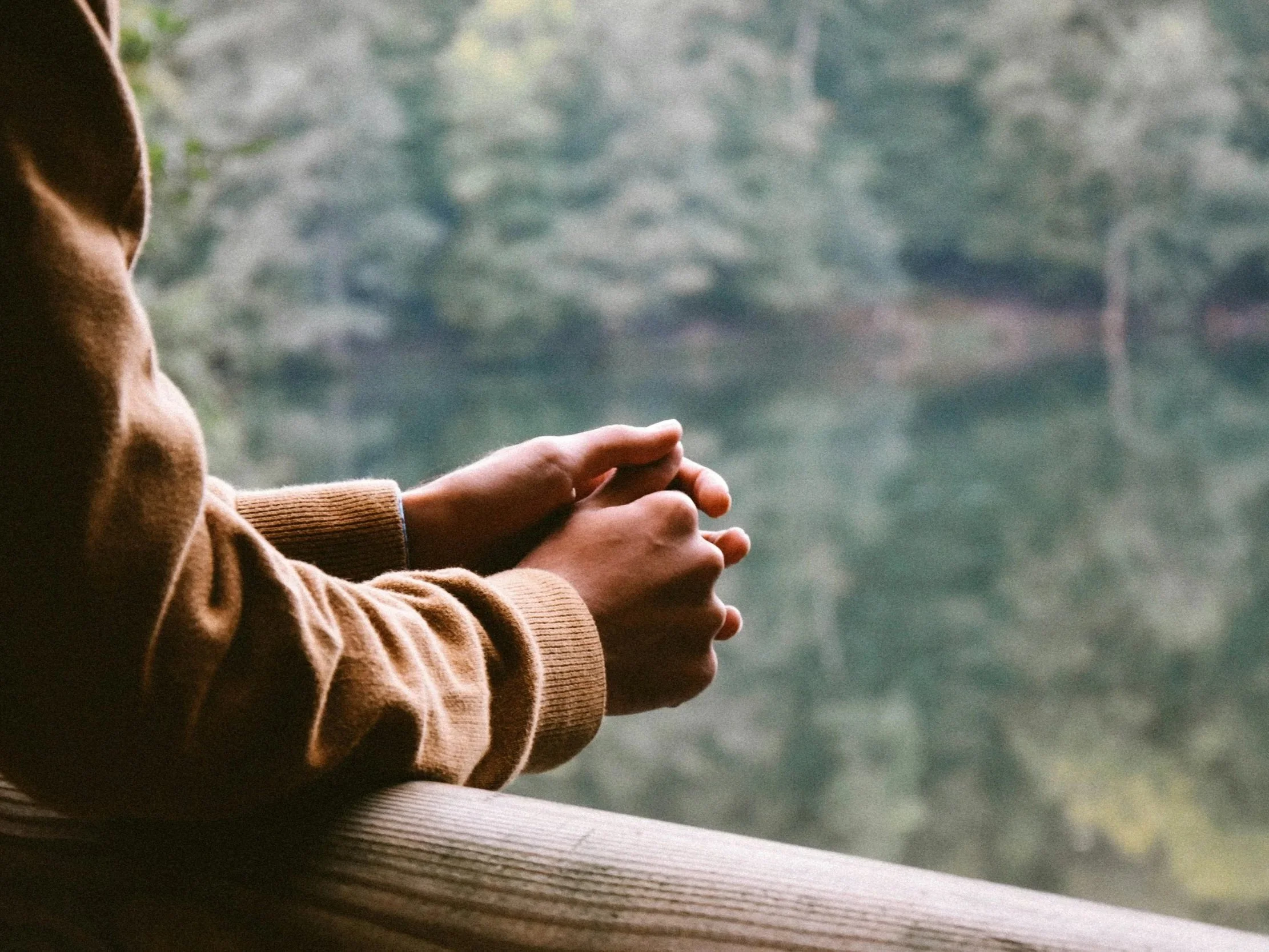
A person resting their hands on a wooden railing while looking out toward a blurred forest landscape, evoking pause, reflection, and the human instinct to mark transitions and endings.
Long before calendars, humans marked time with thresholds. The turning of light. The return of birds. The moment when one season loosened and another took hold. We are creatures who notice edges — not because time requires it, but because our minds do.
Psychology gives this instinct a dry name: temporal landmarks. Moments that divide experience into chapters, allowing the mind to reorganize what has already happened. Birthdays. New jobs. The first morning in a new place. These markers do not change the facts of a life, but they change how those facts are held. They offer a pause — brief, often fragile — in which meaning can be rearranged.
Without such pauses, time becomes a continuous surface. Events accumulate without settling. Joys blur. Losses remain sharp. The mind keeps carrying what was never properly set down.
This is why endings matter, even when nothing outward has ended at all.
The final day of the year is, in practical terms, arbitrary. One more rotation, one more midnight. And yet it presses on us with a particular gravity. It invites reckoning, even from those who resist it. The question is not whether we will reflect, but how — loudly or quietly, with spectacle or with attention.
Rituals, despite their reputation, are not acts of superstition. They are cognitive structures: deliberate interruptions in ordinary time that allow experience to be integrated rather than merely endured. They slow perception. They make room for emotion to register without needing to justify itself. They say, in effect: something has passed; notice it.
Modern life offers very few such interruptions. Digital spaces accelerate rather than pause. Social platforms reward immediacy, performance, and resolution — a neat ending, a declared lesson, a visible outcome. Even reflection is often shaped into content, something to be shared, optimized, reacted to.
But the mind does not always move in straight lines. It processes in loops, fragments, half-formed impressions. It needs intervals that are not productive, not documented, not resolved.
A walk at the edge of the year provides one.
Not because it explains the past twelve months, but because it creates a container in which they can be felt without analysis. The body moving forward gives the mind permission to stop chasing conclusions. The repetitive rhythm of steps tells the nervous system that it is safe to slow down. Thoughts rise and fall without needing to be organized into a verdict.
In this way, marking an ending is not about closure in the cinematic sense — a bow tied neatly around experience. It is about acknowledgment. About letting the year register as something that happened, rather than something still demanding response.
The forest does not offer answers. It offers conditions: quiet, continuity, a pace older than urgency. Within those conditions, the mind does what it has always done when given enough space.
It sorts.
It softens.
It lets go of what cannot be carried forward unchanged.
Without a pause, the year simply continues — unprocessed, unfinished, trailing its weight into whatever comes next.
And so we step into the trees, not to make meaning, but to give meaning a place to arrive.
The forest as a non-demanding witness
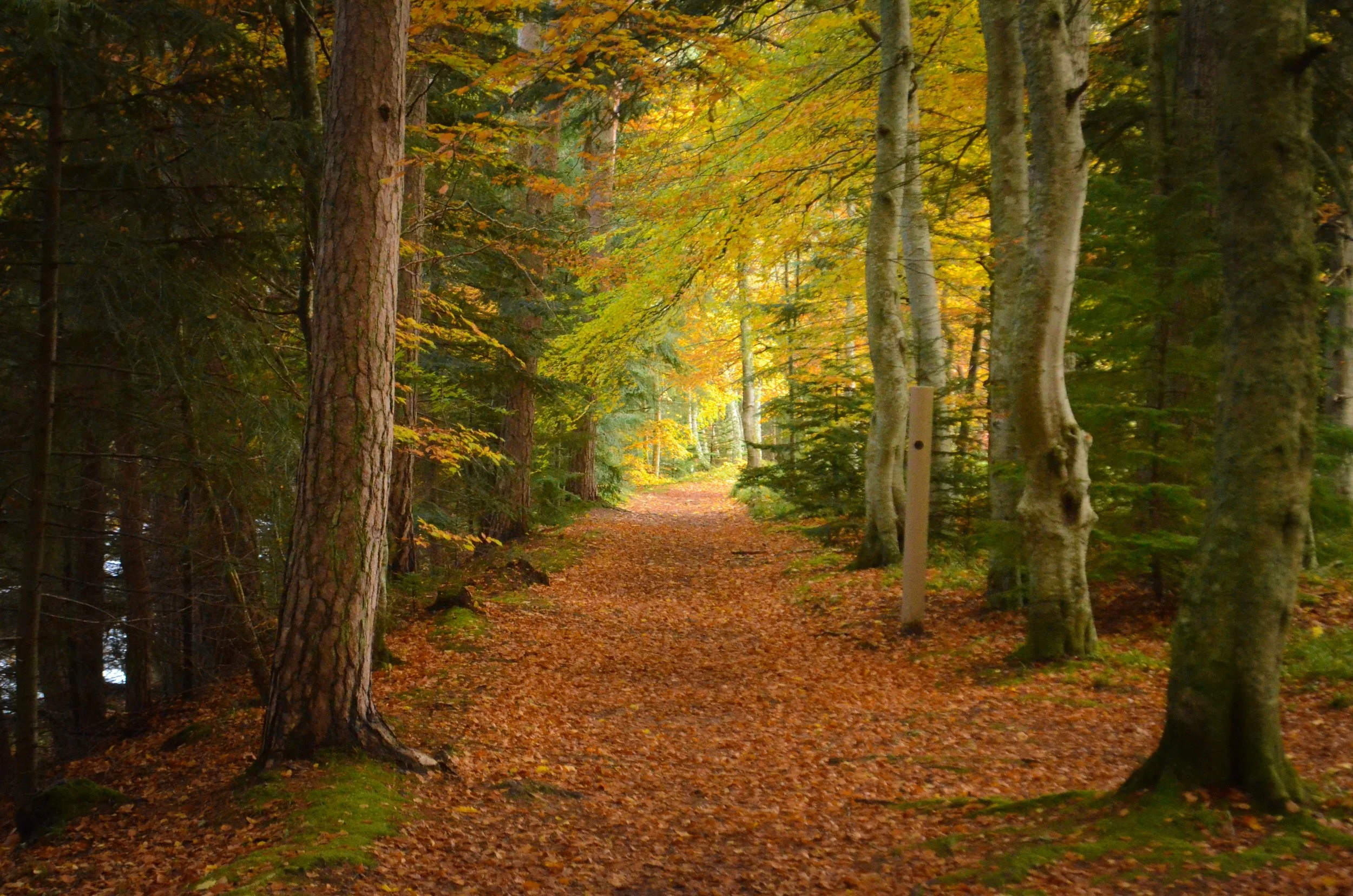
A quiet forest path covered in fallen leaves, lined with tall trees on both sides, offering a sense of stillness, continuity, and an undemanding natural presence.
The forest is not chosen as an escape. That language suggests flight, avoidance, a turning away from what is difficult. But nothing here is left behind. The year comes with you — every unfinished thought, every tenderness still sore to the touch. The forest simply refuses to interrogate it.
Unlike human spaces, natural environments do not require explanation. They do not ask for coherence, productivity, or self-definition. There is no audience here, no implied verdict. The trees do not reflect you back to yourself. They do not confirm your progress or question your choices. They stand, and in standing, they make room.
Psychologists sometimes describe this quality as soft fascination — a form of attention that is engaged but not strained. Leaves shifting in wind. Light fracturing through branches. The low, continuous texture of natural sound. These elements hold awareness gently, allowing the mind to rest from its habit of constant evaluation. In such conditions, mental fatigue eases, not through effort, but through permission.
This is a rare thing.
Most environments we move through are demanding by design. Screens ask to be interpreted. Messages ask to be answered. Even moments of leisure arrive packaged with metrics — steps counted, minutes tracked, outcomes measured. Identity itself becomes a task to be maintained, updated, defended.
The forest asks for none of this.
Here, attention does not have to perform. It can widen or narrow without consequence. You may notice the geometry of bare branches against the sky, or you may stare at the ground, tracking the erratic lines of roots and fungi. Both are acceptable. Neither is improved by narration.
The absence of demand has a subtle effect. When nothing outside you requires resolution, the urgency inside you begins to ease. Self-narratives — the stories told repeatedly throughout the year about success, failure, direction — lose some of their grip. They are not disproven. They are simply no longer necessary.
In this way, the forest becomes a witness rather than a mirror.
A mirror reinforces identity. A witness allows it to loosen.
The trees have stood through countless endings. They have absorbed storms, droughts, human noise, human absence. Some have lost limbs, others have grown quietly around old damage, incorporating disruption into form. Their presence does not dramatize survival. It normalizes it.
Walking among them at the year’s edge, you sense this continuity not as reassurance, but as perspective. Your year — its weight, its intensity — is real, but it is not singular. It exists within a longer, steadier rhythm that neither dismisses nor magnifies it.
This is why clarity sometimes arrives here without effort. Not because problems are solved, but because they are held at a different scale. The forest does not offer guidance. It offers proportion.
And proportion, in a culture of constant amplification, can feel like relief.
The year does not need to be judged tonight.
It needs only to be witnessed — quietly, without demand, as it passes.
Walking until the year can settle
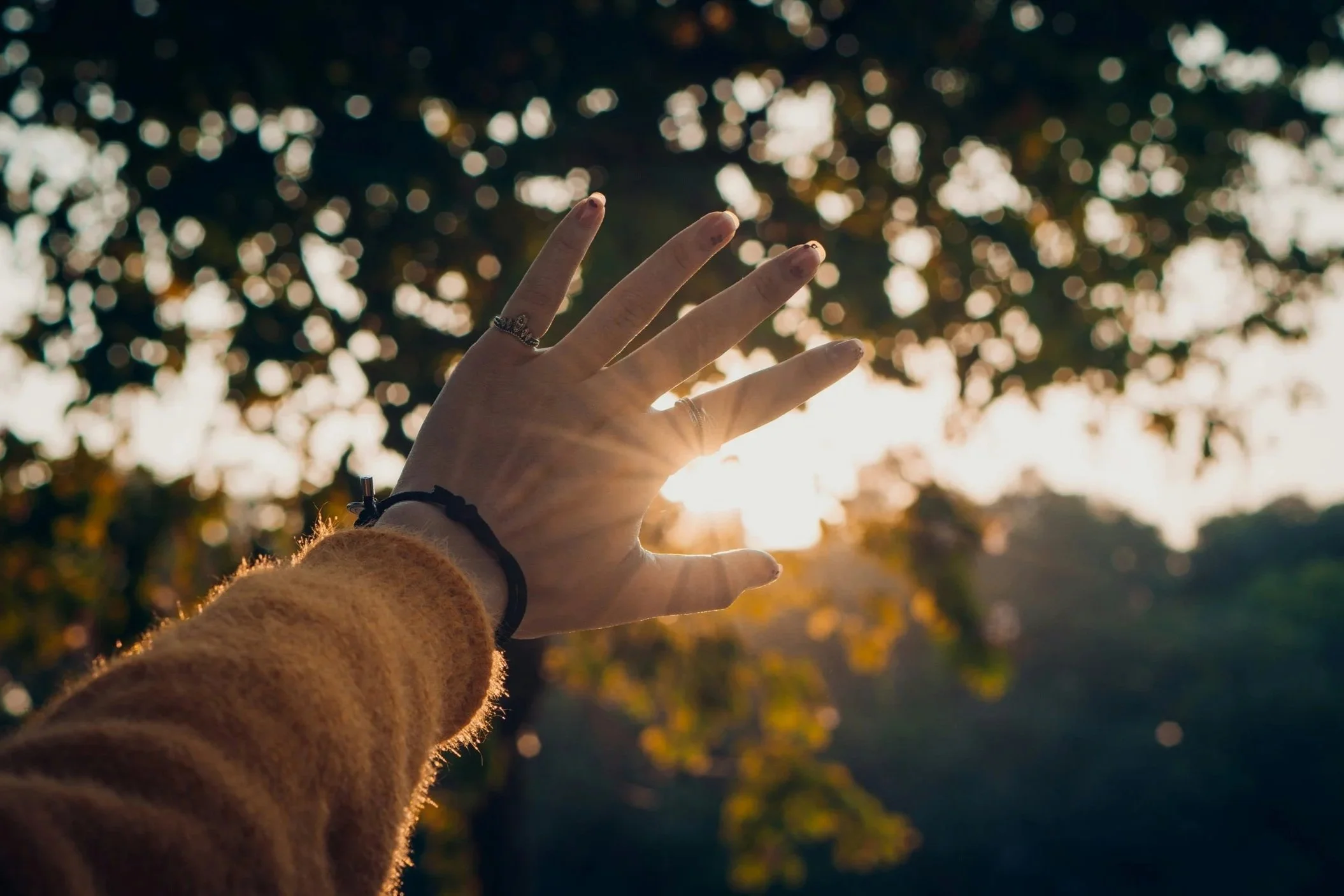
A hand raised toward low sunlight filtering through trees, capturing a moment of movement, pause, and sensory awareness during a walk as the year gently comes to rest.
Walking has always been one of the body’s quieter forms of thinking. Long before analysis, before explanation, before language tries to make sense of what it feels, the body begins to move — and in moving, it regulates what the mind has been holding too tightly.
There is a reason thoughts rearrange themselves when the feet fall into rhythm. Repetitive motion steadies the nervous system. Breath syncs to pace. Muscles take over some of the work the mind has been doing alone. Emotion, which resists direct command, responds to this indirectly — loosening when it feels supported rather than interrogated.
This is not escape. Nothing is being outrun.
The year is still present: the fatigue, the tenderness, the unresolved edges. But here, they are allowed to arrive at the speed the body can tolerate. Not all at once. Not demanding conclusion. Just enough to be felt without overwhelm.
The forest path curves and straightens. The ground alternates between soft and uncertain. Each step asks for attention, but not interpretation. In this way, walking becomes a form of integration — the gradual settling of experience into something the body can carry forward.
You do not leave the year behind on this path.
You let it land.
Some people, consciously or not, allow the walk to take on a slight structure. Not rules — more like gentle gestures of attention. Walking without headphones. Pausing once, somewhere unremarkable. Noticing what insists on being remembered, and what quietly asks to be released.
There is no correct way to do this. No prescribed moment of insight. Meaning emerges sideways, if at all. A phrase surfaces and fades. A memory sharpens, then softens. The mind names something — this stays — and later names something else — this can rest now.
This is what ritual actually is: attention, shaped just enough to be felt.
The forest does not require it. The year does not demand it. But the mind recognizes the difference between time that merely passes and time that has been acknowledged.
Eventually, the walk begins to turn back toward its beginning. Light has drained almost entirely from the sky. The cold presses closer. Somewhere beyond the trees, ordinary life continues — kitchens lit, phones vibrating, clocks advancing with mechanical indifference.
Nothing dramatic has happened.
There are no answers waiting at the edge of the path. No resolution offered in exchange for attention. What arrives instead is subtler: a widening of inner space. A softening of the voice that narrates success and failure. A sense that the year, whatever it contained, no longer needs to be held quite so tightly.
Clarity, it turns out, does not always arrive as certainty.
Often it arrives as room.
Room to enter the next year without dragging every judgment forward.
Room to let some stories end without needing to explain why.
Room to carry what matters, and leave the rest unforced.
When you step out of the forest, the world resumes its brightness and its noise. Time snaps back into numbers. Midnight approaches whether you are ready or not. But something quiet crosses the threshold with you — not a lesson, not a resolution, but a steadier internal pace.
Some years end with fireworks and declarations.
Others end with cold air in the lungs, damp ground underfoot, and a body that has finally been allowed to slow.
And that, too, is a way of beginning.
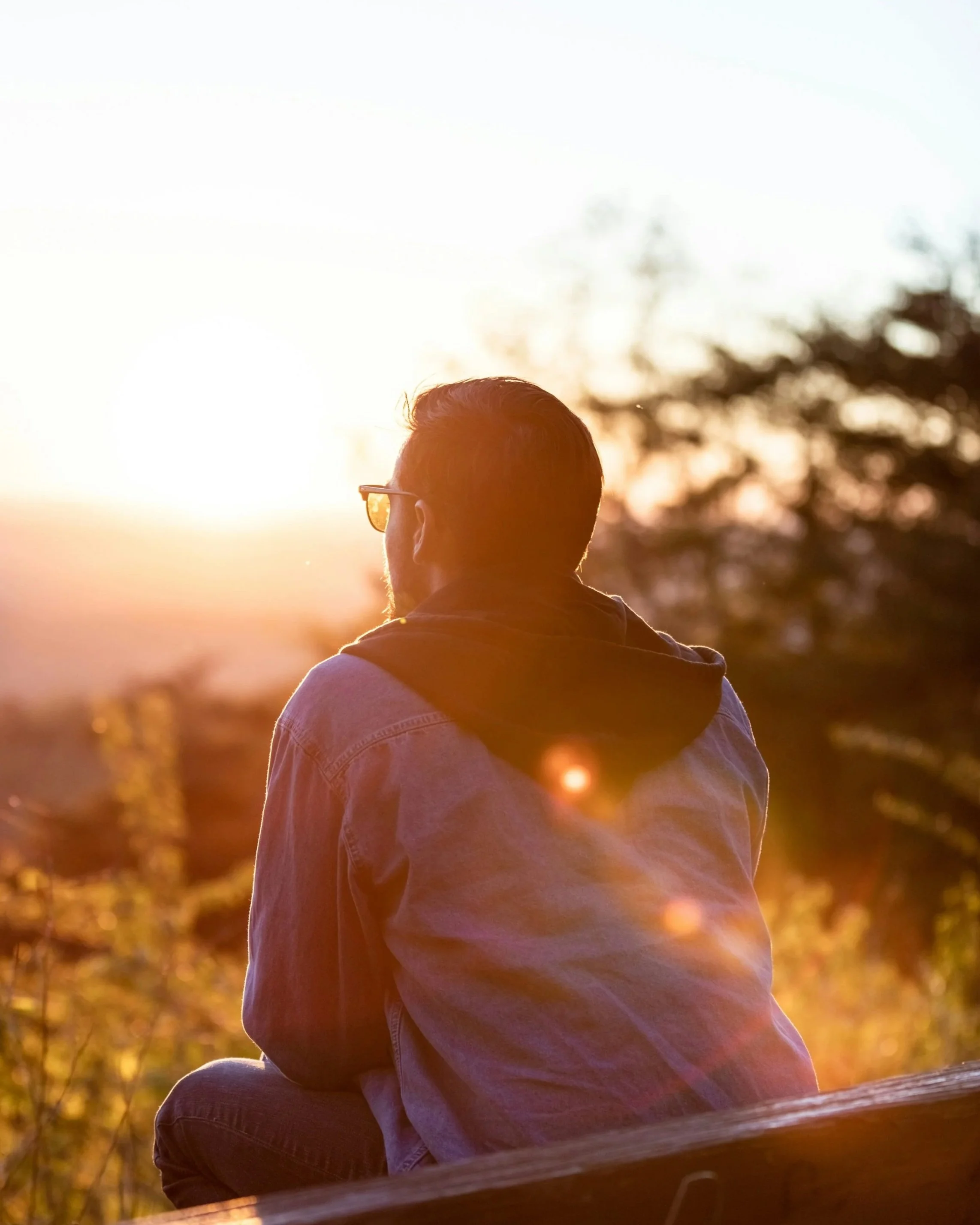
A person sits on a bench at sunset, facing an open landscape as daylight fades at the end of the year.