Why Hawthorn is Ireland’s most magical — and most ecologically important — tree
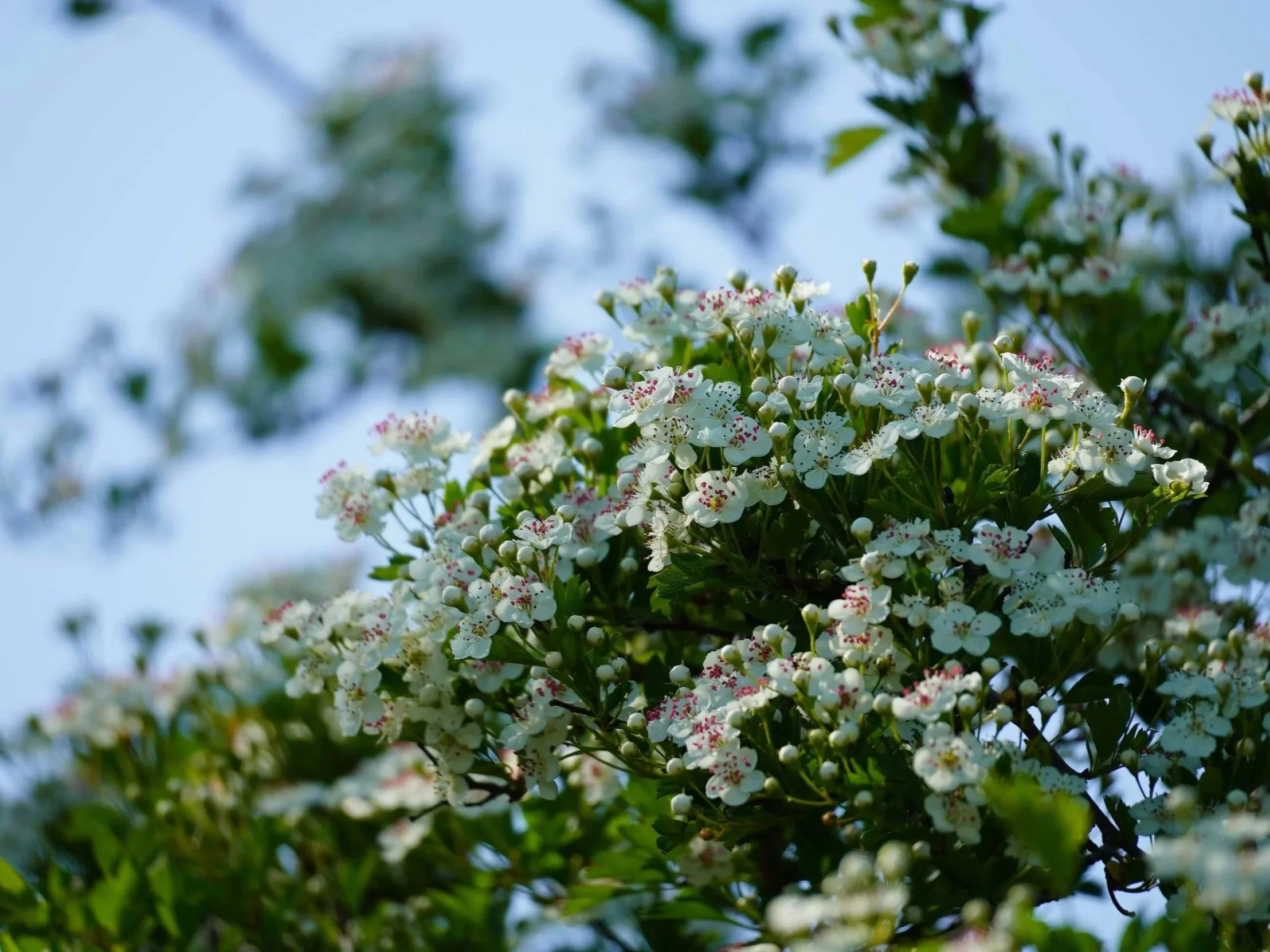
A close-up of hawthorn blossom (Crataegus monogyna) in full May bloom, its white flowers dusted with pink anthers against a soft Irish sky. Flowering hawthorn hedgerows are a vital late-spring food source for pollinators and are deeply rooted in Irish folklore as sacred “fairy trees” associated with thresholds and protection.
The tree you do not touch
At the edge of a grazed field, where grass thins and machinery turns back, a hawthorn often stands alone. It is rarely tall. It does not announce itself like an oak, nor brood like a yew. It is thorned, compact, almost apologetic in posture. And yet it remains when everything else has been cleared. Fences bend around it. Roads swerve. Plough lines hesitate. This is the tree you do not touch.
In Ireland, such lone hawthorns are known as fairy trees — left standing not out of sentimentality, but caution. They are small enough to ignore, but dangerous enough to respect. For centuries, farmers, builders, and road planners have chosen inconvenience over interference, unwilling to risk what might follow if the tree were cut. Misfortune, sickness, bad luck. The stories are many, and remarkably persistent.
This is the paradox of hawthorn (Crataegus monogyna). It is modest, thorny, unassuming — and yet deeply feared, revered, protected. A tree both ordinary and charged. Both botanical and mythic.
Hawthorn is, at once, a cultural keystone and an ecological keystone. Its roots run not only through soil, but through story; its branches hold both blossom and belief. To understand hawthorn is to stand at a threshold, where folklore meets pollinator, and memory becomes landscape. This is not just a tree. It is a crossing point.
A tree between worlds: Hawthorn in irish folklore
The fairy tree and the danger of removal
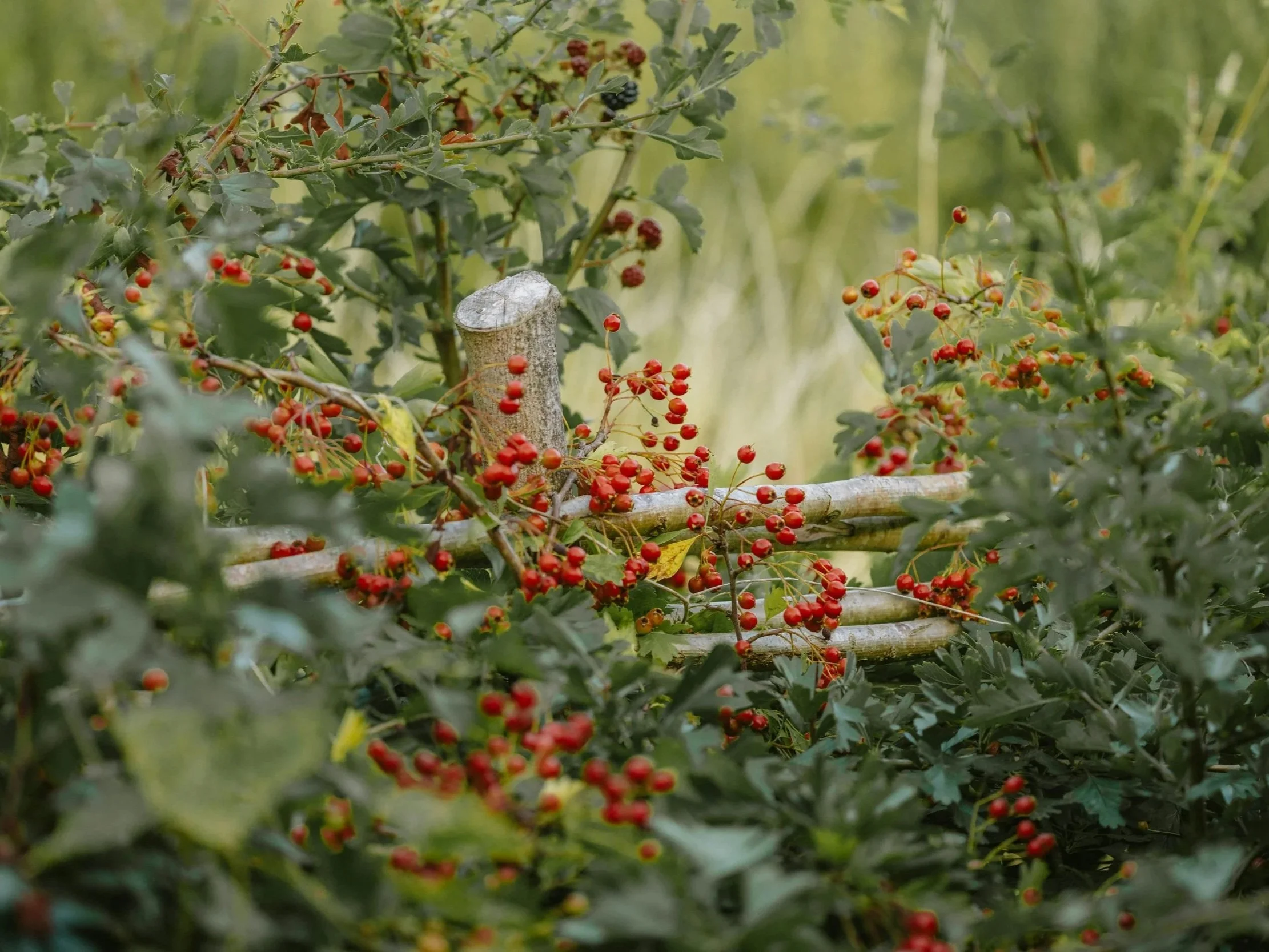
A cut hawthorn tree lying among dense foliage, its branches heavy with red haws, illustrating the traditional Irish belief that fairy trees should never be removed. Hawthorn (Crataegus monogyna) is deeply embedded in Irish folklore as a sacred tree associated with the Aos Sí, and its cutting is historically linked to misfortune, disruption, and ecological loss.
In Irish folklore, the hawthorn is not simply associated with the Aos Sí — the fairy people — it is inhabited by them. Lone hawthorns, especially those standing at field edges, crossroads, or near ring forts, are understood as dwellings, meeting places, or passage points between worlds. To cut one down is not an act of land management, but a provocation.
The stories that grew around these trees are remarkably consistent. A farmer removes a hawthorn and loses his livestock. A road crew fells a fairy tree and suffers a string of accidents. A developer ignores warnings and watches machinery fail again and again. Even into the late twentieth century, there are recorded cases of infrastructure projects being rerouted to avoid a single hawthorn left standing in an otherwise empty field.
What is striking is not merely the belief itself, but its endurance. These stories persisted through colonisation, famine, modernisation, and mechanised agriculture. They survived the transition from oral culture to written record, from horse-drawn plough to diesel engine. In a landscape otherwise reshaped repeatedly and often brutally, the hawthorn remained.
Thresholds, liminality, and seasonal magic
Hawthorn’s power is bound to timing as much as place. It flowers around Bealtaine — May Day — the ancient festival marking the beginning of summer, a moment when boundaries soften and the world is thought to open. The hawthorn bloom is brief, explosive, and exact. It arrives suddenly, foaming white along hedges and field margins, then vanishes just as quickly.
This liminal quality made hawthorn a tree of contradiction. It symbolised fertility and marriage, yet its flowers were associated with death, their scent likened to decay. Bringing hawthorn blossom indoors was considered dangerous — an invitation to illness or bad luck. The tree offered protection, but demanded distance.
Unlike the oak, emblem of strength and kingship, or the yew, keeper of graveyards and deep time, hawthorn occupied a narrower, sharper space. It was a boundary tree. A warning tree. A marker of where not to cross carelessly.
Folklore as an early conservation ethic
Seen through a modern lens, these beliefs can be read as superstition. But they functioned as something else entirely: restraint. Fear became protection. Taboo became preservation. In a farming culture where wood was fuel, fencing, and shelter, the hawthorn was spared not because it was useful, but because it was dangerous in another way.
Long before biodiversity loss had a name, hawthorn was already being left alone. Its survival was written into story, enforced by consequence, and carried forward by attention. The folklore did not save the tree accidentally. It saved it deliberately — by insisting that some things should not be touched.
From here, the story of hawthorn moves from the unseen world into the living one: from fairy paths to flight paths, from belief to bloom. What the stories protected, ecology would later reveal as indispensable.
The May bloom: Hawthorn and pollinators
A brief, explosive season of abundance
For most of the year, hawthorn keeps itself closed. Its leaves are small, its branches defensive, its presence easily overlooked among the green noise of hedges. Then, almost overnight, it changes state. In late spring, usually somewhere between the last cold hesitation of April and the first settled warmth of May, the hawthorn breaks open.
Blossom arrives not delicately, but in force. Whole hedgerows whiten at once, as if froth has been lifted from the ground and caught in the branches. Each flower is simple — five petals, pale and open — but together they create a density that feels deliberate, urgent. This abundance is short-lived. A week or two, sometimes less, depending on wind and rain. Miss it, and the moment is gone.
The scent of hawthorn is famously divisive. Some describe it as sweet, almond-like, bright. Others catch something darker: musk, rot, the faint tang of decay. Both are true. Chemically, the flowers contain compounds also released as bodies break down. It is a smell that unsettles because it refuses to be only pleasant. Like the tree itself, it exists between attraction and warning.
Timing is everything. Hawthorn blooms during a late-spring gap, when many earlier flowers have faded and summer abundance has not yet begun. In ecological terms, this is a bottleneck — a moment of need. Hawthorn answers it precisely.
Pollinators that depend on Hawthorn
When the hawthorn flowers, insects arrive in numbers. Not just the obvious ones — honeybees and bumblebees — but solitary bees emerging briefly to feed and reproduce, hoverflies mimicking wasps in mid-air stillness, beetles dusted yellow with pollen, moths lingering into daylight. The tree does not specialise. It welcomes.
Hawthorn flowers are structurally generous. Their open form allows access to insects of many sizes and shapes. There are no deep tubes to exclude short tongues, no complex barriers requiring strength or precision. Nectar and pollen are offered plainly, repeatedly, across thousands of blossoms.
For some species, this matters profoundly. Early-emerging solitary bees rely on short windows of flowering to provision their nests. Hoverflies — many of whose larvae will later consume aphids — need energy sources that coincide with their appearance. Hawthorn provides not efficiency, but reliability. It is there when it is needed.
This is why hedgerows hum in May. Stand beside a flowering hawthorn and you can hear it working: a low, continuous sound made of wings and movement and brief landings. Life converges.
Pollination as relationship, not service
Modern language often reduces this exchange to function. Pollinators provide a service. Plants offer a resource. The transaction is measured in yields and losses. But hawthorn resists that framing. What happens here is not optimisation, but mutual survival.
The tree flowers extravagantly, risking energy on a season that may be ruined by frost or rain. Insects arrive en masse, exposed, feeding in the open. Both are vulnerable. Both persist anyway.
This older understanding echoes the folklore. Hawthorn’s May bloom was considered a gift — powerful, dangerous, not to be taken lightly. Cutting branches in flower, especially to bring indoors, was taboo. You could admire, but not possess. The gift was meant to remain where it was.
Seen this way, pollination is not extraction. It is attention returned. A relationship carried out in days, but sustaining lives that will extend into summer and beyond.
By June, the petals will fall. The hedge will green over. The moment will pass. But its effects will remain, folded into berries, into larvae, into birdsong still to come.
The threshold has been crossed again — quietly, efficiently, and almost entirely unnoticed.
A spine in the landscape: Hawthorn and biodiversity
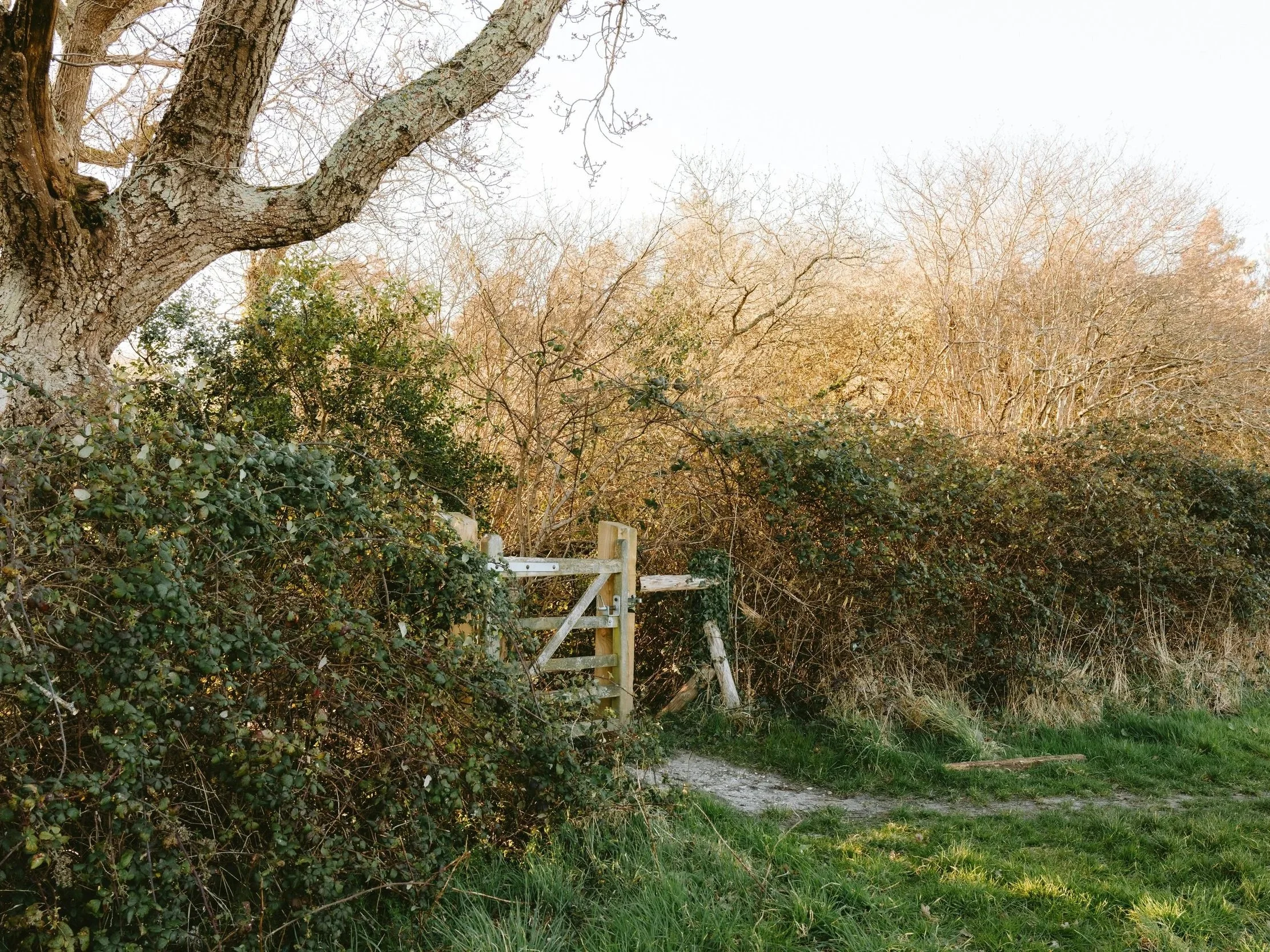
An Irish hedgerow dominated by hawthorn forming a dense living boundary along a rural path, with a wooden gate opening into surrounding farmland. Hawthorn hedges are a cornerstone of Ireland’s biodiversity, acting as wildlife corridors, nesting habitat, and ecological spines that connect fragmented landscapes.
To understand hawthorn in Ireland, you have to stop thinking of it as a single tree. Hawthorn is structure. It is the architecture that holds much of the countryside together.
For centuries, hawthorn has been the backbone of Irish hedgerows. Planted, laid, and encouraged along field boundaries, it shaped the patchwork of farms and townlands that emerged long before the Ordnance Survey put names to them. In places, these hedges trace medieval field systems; in others, they mark post-Famine reorganisations of land. Wherever they run, they bind history to ecology.
A hedgerow is not a line. It is a corridor. It moves animals safely through open land, allowing them to forage, disperse, and survive without crossing exposed ground. It offers shelter from wind and rain, moderates temperature, and slows the movement of water across soil. In an intensively managed landscape, hedgerows are the remaining connective tissue.
Hawthorn excels here because it tolerates cutting, responds to laying, and grows densely enough to close gaps. It creates boundaries that are porous to life but resistant to pressure — a living fence that feeds what it protects.
Who lives in a Hawthorn?
The question is not rhetorical. A mature hawthorn supports hundreds of species, many of them unseen.
Birds nest deep within its thorned branches: blackbirds, robins, wrens, linnets, yellowhammers. The thorns deter predators, turning the tree into a safe chamber for eggs and fledglings. Later in the year, the haws — small red berries — persist into winter, feeding thrushes and finches when other food has vanished.
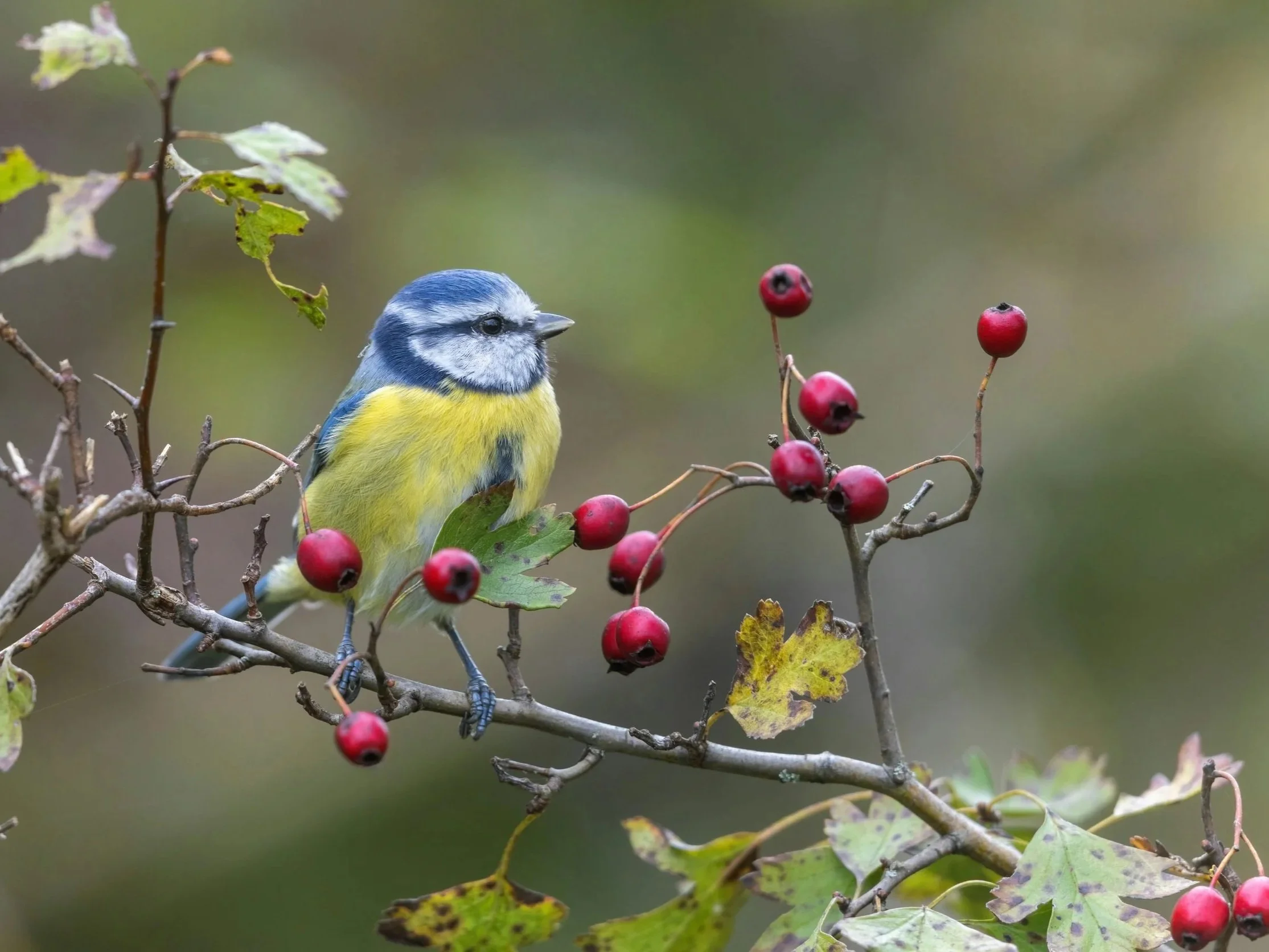
A blue tit perched among red hawthorn berries in an Irish hedgerow, illustrating how hawthorn trees provide vital winter food and shelter for birds and wildlife across Ireland’s farmland landscapes.
Mammals move through hawthorn hedges as through cover. Hedgehogs travel their length, feeding on beetles and worms. Field mice and shrews shelter at their bases. Bats follow hedgerows at dusk, using them as navigational guides and hunting routes, skimming insects from the air where the hedge thickens.
Invertebrate life is denser still. Hawthorn leaves host caterpillars of moths and butterflies, including species that feed on few other plants. Aphids gather on new growth, drawing in hoverfly larvae and ladybirds, which in turn attract birds. Each layer supports the next. Remove the tree, and the web loosens.
Thorns as protection, not hostility
It is tempting to see hawthorn’s thorns as aggression — nature armed and defensive. Ecologically, they are something else entirely. Thorns protect without excluding. They discourage overgrazing, allowing young shoots to survive. They shield nests without sealing them off. They create interior space.
In landscapes shaped by mouths — sheep, cattle, deer — this matters. Without thorned species, regeneration fails. Hawthorn holds ground where softer trees are eaten back before they can establish. Its defences are not about dominance, but persistence.
There is a metaphor here, quietly embedded in the wood. Boundaries are not always acts of violence. Sometimes they are acts of care. Hawthorn does not retreat from the world; it negotiates with it.
Through hedge and field margin, it becomes a spine — not showy, not central, but essential. Remove enough of these spines, and the landscape collapses into fragments.
What remains after that is quieter, poorer, and far more exposed.
Memory in the wood: ancient trees, old hedges, and time
Some hawthorns are far older than they appear. Slow-growing and easily overlooked, they do not advertise age through height or girth. Instead, they hold time inwardly, knotting it into twisted trunks and hollowed cores. An old hawthorn can be centuries old — contemporary with vanished farms, erased lanes, forgotten names.
Ireland’s oldest hedgerows function as living records. They trace pre-Famine field systems, map the outlines of smallholdings that no longer exist, mark the margins of labour that was once daily and local. Where stone walls fell or timber was taken, hawthorn remained, growing thicker with each generation of cutting and regrowth.
To walk beside an old hedge is to read a history written without ink. Each bend follows an earlier boundary. Each surviving tree signals a decision not to remove it — repeated over decades, sometimes centuries. The archive is cumulative, built not through preservation, but through continuity.
Survival through neglect
Hawthorn endured not because it was favoured, but because it occupied the margins. It grew where ploughs could not reach, where soil was thin, where effort outweighed reward. It thrived in neglect, in places deemed unimportant.
This is a quieter kind of resilience. Hawthorn did not dominate the canopy. It accepted edges, adapted to pressure, and persisted through repetition. Cut back, it returned. Ignored, it aged.
In this way, hawthorn mirrors the histories of many rural landscapes — survival through being left alone, through usefulness that did not demand attention. Its memory is not monumental. It is domestic, cumulative, patient.
What we are losing (and still can save)
Modern threats
The forces that threaten hawthorn today are rarely dramatic. There are no axes raised in anger, no open defiance of fairy warnings. Instead, loss arrives through tidying.
Hedgerows are removed to enlarge fields. Lone trees are cleared because they are inconvenient. Mechanical flailing — done too often or at the wrong time of year — strips flowers before insects arrive and berries before birds can feed. What remains is a line of wood, trimmed into silence.
In many places, the countryside is being simplified. Edges are erased. Complexity is smoothed out. The small interruptions that once held life are treated as inefficiencies.
If hawthorn blooms before pollinators are active, or after they have passed through their peak, the relationship falters. The tree may still flower. The insects may still exist. But the meeting fails.
This is where hawthorn’s resilience matters. Diverse hedgerows buffer against change. Old systems absorb disruption better than simplified ones. Protecting hawthorn is not nostalgia — it is strategy.
What is lost when hawthorn disappears is not just a species, but a pattern of connection refined over centuries.
The tree that still stands
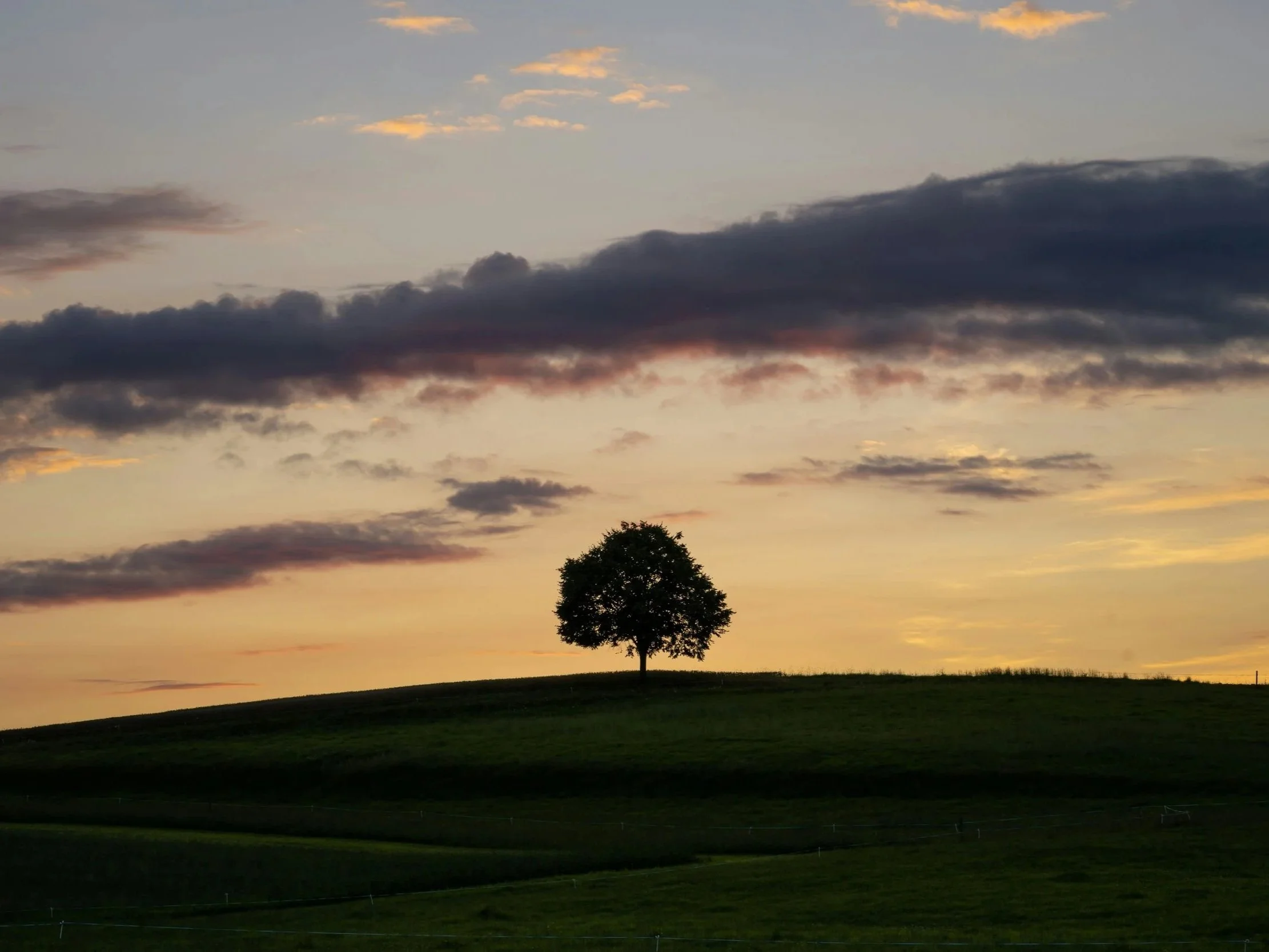
A solitary hawthorn tree stands on a grassy rise beneath a wide evening sky, its silhouette untouched in an otherwise managed landscape. In Ireland, such lone hawthorns are known as fairy trees — often left standing out of respect, caution, and tradition — and continue to serve as ecological anchors for wildlife at the edges of fields.
Return, finally, to the field edge. The lone hawthorn is still there, its branches weathered, its outline familiar. It has been passed by seasons, storms, machines. It remains.
Seen clearly, this tree is not a curiosity. It is a guardian. A connector. A survivor. It holds insects in spring, birds in winter, stories year-round. It anchors hedges, slows water, softens wind. It teaches restraint simply by standing.
Folklore was not superstition. It was attention — a way of noticing what mattered before there were words for ecology. Science has not replaced that knowledge; it has translated it.
Hawthorn reminds us that limits are not failures. Edges are not weaknesses. Small trees can hold whole worlds.
In protecting the hawthorn, Ireland was protecting itself — long before it knew it needed to.