Deadliest creatures in Earth’s history: prehistoric animals that would easily kill you today
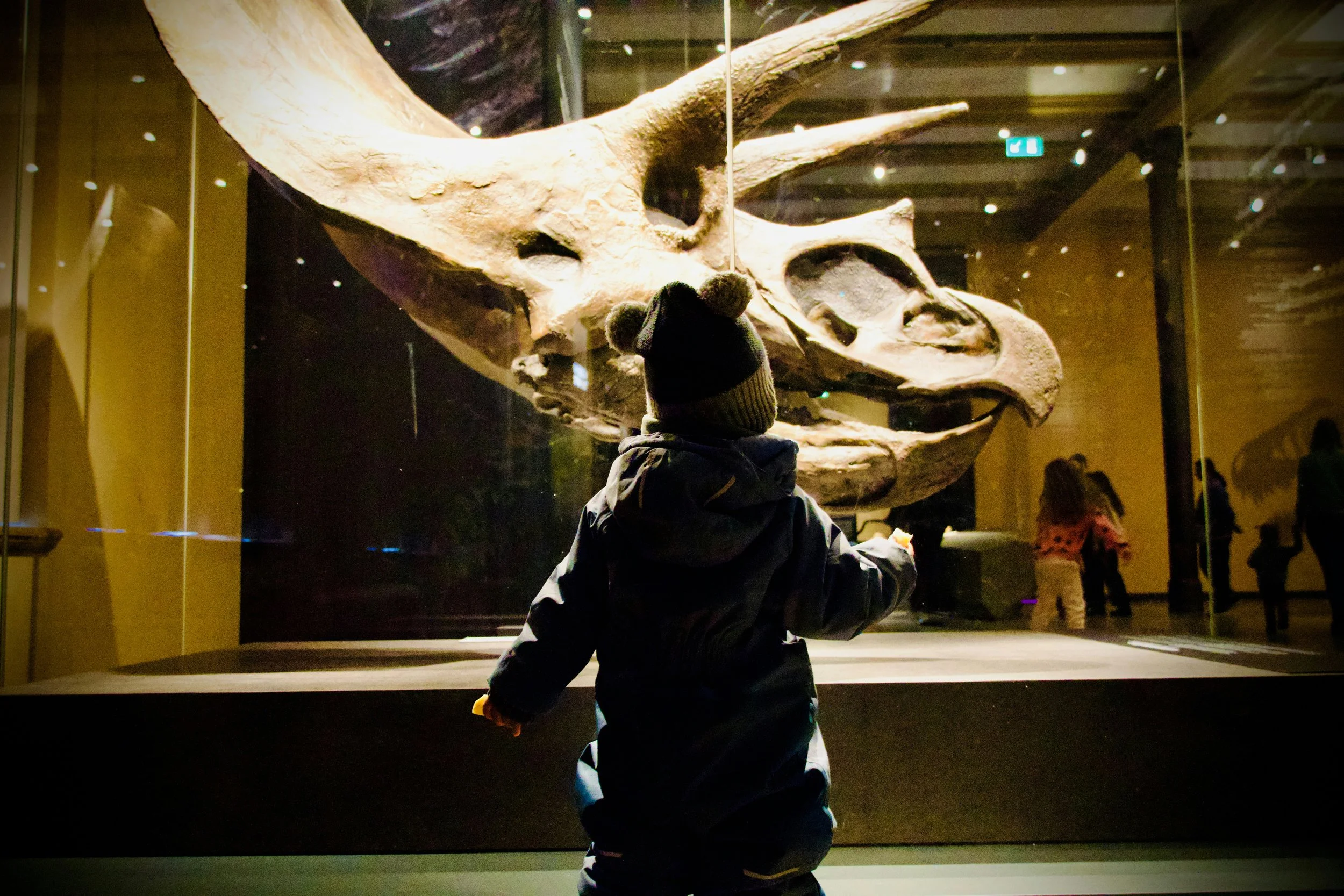
A young museum visitor gazes at the gigantic fossil skull of an ancient predator, illustrating the immense scale and evolutionary power of the deadliest creatures that once dominated Earth.
Meeting Earth’s deadliest predators
In the quiet hush of a modern forest, we may walk with a sense of security, shielded by walls, roads, and laws. Yet, if we could roll back the clocks sixty-eight million years, or dive into oceans twenty-three million years past, we would confront a different world entirely, a world where survival was measured in teeth, claws, and the unforgiving logic of predation. This is the story of the deadliest creatures in Earth's history, of predators whose very existence was a testament to the extremes evolution could achieve.
These were animals honed by time, sculpted by ecological pressures, and crowned as apex predators in worlds where the stakes were life or death. Here, we explore what it meant to be deadly, and meet the monsters that could, with ease, claim a human life today.
What makes a creature “deadly” in evolutionary terms?
To be lethal is to be a master of staying alive. Scientists often define an apex predator as an organism at the top of its food chain, unthreatened by other species, capable of exerting influence over its ecosystem. But apex status alone does not guarantee lethality; it is the combination of anatomical prowess, sensory acuity, and hunting strategy that truly determines the deadliest.
Consider these key dimensions:
Bite Force: The sheer pressure an animal can exert when clamping down, measured in tons or newtons. Tyrannosaurus rex, for instance, could generate up to six tons of force, enough to crush bone as easily as a walnut (McKeever, n.d.).
Venom Potency: For snakes and arthropods, venom is evolution’s shortcut to subduing prey, converting chemical potency into immediate lethality. Titanoboa may have relied less on venom, but other prehistoric serpents leveraged it fully.
Speed and Ambush Capability: Hunting success often depended on the predator’s ability to close distance rapidly, strike suddenly, or stalk without detection. Even a creature with modest bite force could be deadly if it struck with timing and precision.
Size vs Lethality: Bigger does not always mean deadlier, but in many prehistoric giants, size amplified every advantage. Megalodon’s colossal jaws and immense mass turned the oceans into a killing field.
Sensory Superiority: Keen smell, acute vision, or environmental awareness could make a predator effective far beyond its physical limitations. T. rex’s olfactory genes rivaled those of domestic cats, allowing it to sniff out prey and carrion alike (Smithsonian Institute, 2014).
Quick reference – deadly traits at a glance:
Bite force: T. rex, Megalodon
Size: Titanoboa, Sarcosuchus
Ambush speed: T. rex, Jaekelopterus
Venom: Certain prehistoric snakes and arthropods
Sensory sharpness: T. rex, Megalodon
The deadliest creatures in Earth’s history
Across eras and ecosystems, life experimented with extremes. Here we meet the apex predators who defined them.
🦖 1. Tyrannosaurus rex — the bone-crushing apex predator
Imagine standing on a sun-dappled floodplain, the ground trembling under twelve tons of muscle and bone. The T. rex sniffs the air, nostrils flaring, eyes locking onto you. A moment later, its massive jaws snap shut with terrifying precision. Any attempt to run would be futile; even a sprint would fail against its sheer stride. The world narrows to the sound of teeth crushing and a heartbeat that is your own.
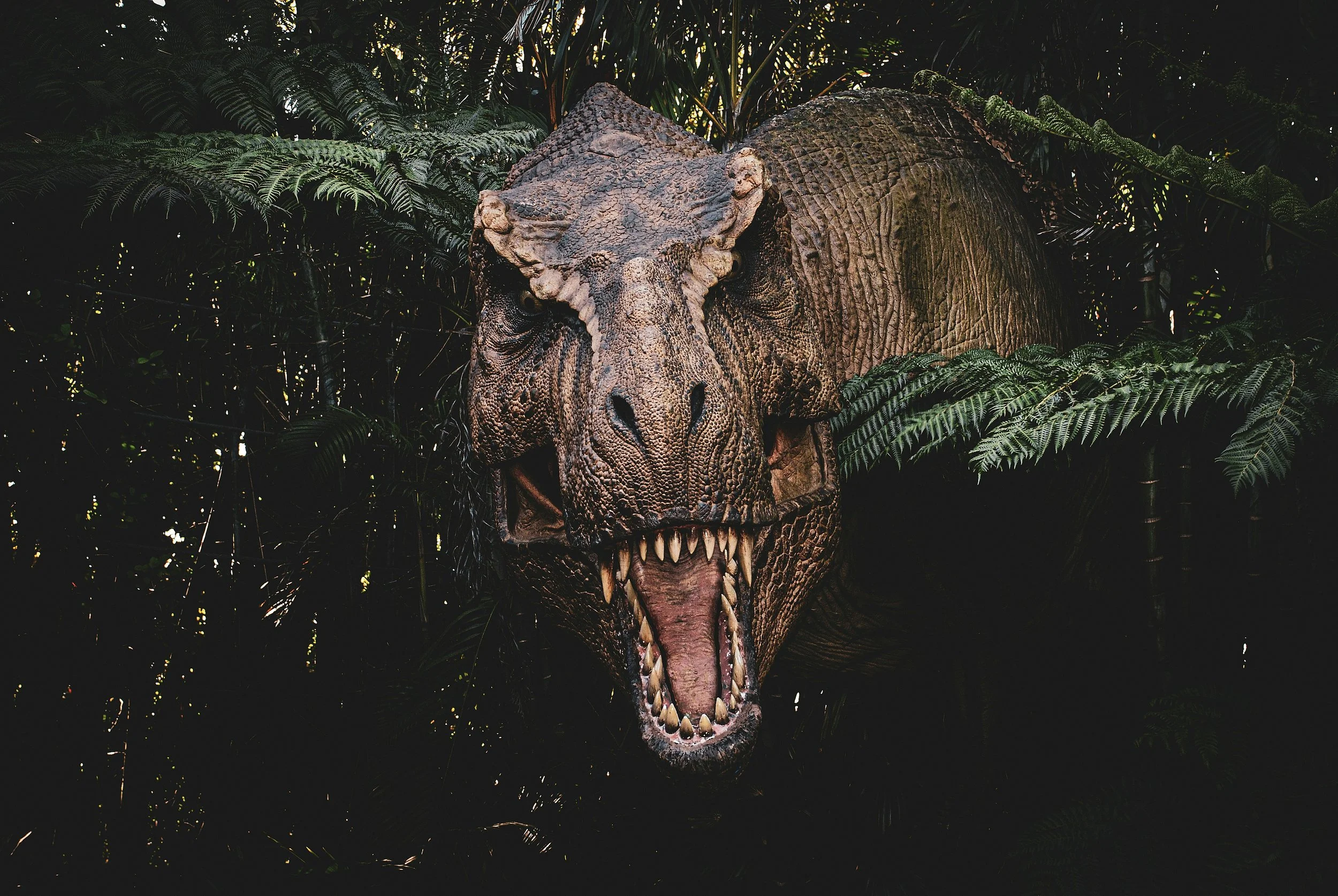
A terrifying reconstruction of Tyrannosaurus rex emerging from dense prehistoric jungle foliage, jaws open to reveal rows of bone-crushing teeth. As one of the deadliest apex predators in Earth’s history, T. rex dominated Late Cretaceous ecosystems with immense bite force, powerful senses, and a body built for predation.
The Tyrannosaurus rex—literally the “king of the tyrant lizards”—lived roughly 68 to 66 million years ago in the lush river valleys of western North America (Geggel, 2024). Standing nearly 12 meters long and weighing up to eight tons, its massive hind legs supported a body designed for dominance, not subtlety. The T. rex’s skull was a marvel of biomechanics: rigid, yet capable of channeling enormous bite force—up to six tons—through its 60 serrated teeth, each capable of slicing, piercing, and gripping with terrifying efficiency (McKeever, n.d.).
Its senses complemented its power. Forward-facing eyes offered depth perception; olfactory receptors rivaled those of modern cats, enabling it to track prey, detect carrion, and perhaps even sense rivals. Yet evolution was not perfect: its famously tiny arms, still a subject of debate, may have assisted in mating or close-quarter struggles, or remained vestigial remnants of an earlier form. Speed, too, was constrained; T. rex likely topped out around 19 km/h, fast enough to pursue most contemporaneous herbivores, but not a cheetah in miniature (Smithsonian Institute, 2014).
Fossil evidence tells a layered story. Bite marks in Triceratops bones, coprolites containing ornithischian remains, and healed cranial injuries suggest T. rex was both a predator and a scavenger, possibly moving in social groups, though the extent of cooperation remains speculative. Its adolescence was a period of rapid growth, followed by a deceleration in adulthood, and most individuals lived up to 28 years. The extinction of T. rex coincided with the Cretaceous–Paleogene event 66 million years ago, when an asteroid reshaped life on Earth forever (Geggel, 2024; Smithsonian Institute, 2014). Its anatomy, life history, and behavior illuminate the broader evolutionary narrative: apex predators are sculpted by their environment, their power inseparable from their ecosystems.
🦈 2. Megalodon — the ocean’s ultimate killer
A human in the ocean, oblivious, feels only the gentle sway of waves, then a shadow eclipses the sunlit waters. The Megalodon, 20 meters of predatory perfection, senses the vibrations of splashing. With a single, cataclysmic bite, a human would vanish in seconds.
Otodus megalodon emerged around 23 million years ago and patrolled the oceans for nearly 20 million years, vanishing only 3.6 million years ago (Davis, 2025). Estimates suggest lengths up to 24 meters and weights nearing 94 tons—larger than any modern great white shark and approaching the mass of a blue whale.
Megalodon’s jaws were extraordinary: a three-meter-wide gape armed with 276 serrated teeth, capable of delivering a bite force between 108,000 and 182,000 newtons, enough to shred whales as effortlessly as a knife through silk (Bradford, 2021). Fossil evidence, including teeth embedded in whale bones, tells of a predator that targeted the largest marine mammals, striking first at flippers and tails to immobilize prey before delivering a fatal blow.
For centuries, megalodon’s teeth were misinterpreted as “dragon tongues,” but modern science clarifies its evolutionary lineage, distinguishing it from the great white shark, and revealing a body built for efficiency, with a short snout and powerful pectoral fins for stability and speed (Davis, 2025). Changes in ocean temperature, prey availability, and competition with emerging shark species likely sealed its fate at the close of the Pliocene.
Even in extinction, Megalodon dominates our imagination. For twenty million years, it was the ultimate apex predator of the seas.
🐍 3. Titanoboa — the 13-meter constrictor
Wading near a prehistoric riverbank, a human glances down, and feels the ripple of water around a sinuous, green-black body. Titanoboa coils, faster than the eye can follow. Its muscular loops tighten around limbs, chest, torso, and finally crush bone and air alike. Escape is impossible; the jungle’s humid air fills the lungs just before the world narrows to darkness.
Long after the dinosaurs vanished, the Earth’s equatorial jungles remained arenas of gigantism. In the Paleocene, some 58 million years ago, Colombia’s Cerrejón coal mine—now a mechanical wasteland—was once a steamy, dense swamp. Here lived Titanoboa cerrejonensis, a serpent so vast it defies the imagination: up to 13–15 meters long and weighing around 1,100 kilograms, its body as long as a bus, its girth rivaling a small rhinoceros (Gugliotta, 2012).
Titanoboa was the apex predator of rivers and swamps. Its dentition and immense jaw allowed it to constrict prey with suffocating force, targeting giant fish, turtles, and even primitive crocodiles. Fossils, first identified in vertebrae long mistaken for crocodile remains, revealed a snake whose sheer size reflected the tropical heat of its environment—reptilian physiology dictated that only such warmth could sustain its extraordinary growth (Yong, 2009).
The discovery illuminated more than a species: it offered a window into Paleocene ecosystems. Giant tortoises and four-meter crocodyliforms shared the swamp, each shaped by environmental pressures as intense as those faced by the dinosaurs before them. A relic of a brutal age, Titanoboa is proof that evolution favors the massive when the world gets hot.
🐊 4. Sarcosuchus — the supercroc
A human crouches by a river, reaching for water. A subtle disturbance, then the eye of a twelve-meter Sarcosuchus breaks the surface. Without warning, the jaws clamp around a leg, dragging its prey beneath the rippling waves. In seconds, the river claims the human, leaving only a fleeting ripple and the shadow of a monster larger than imagination.
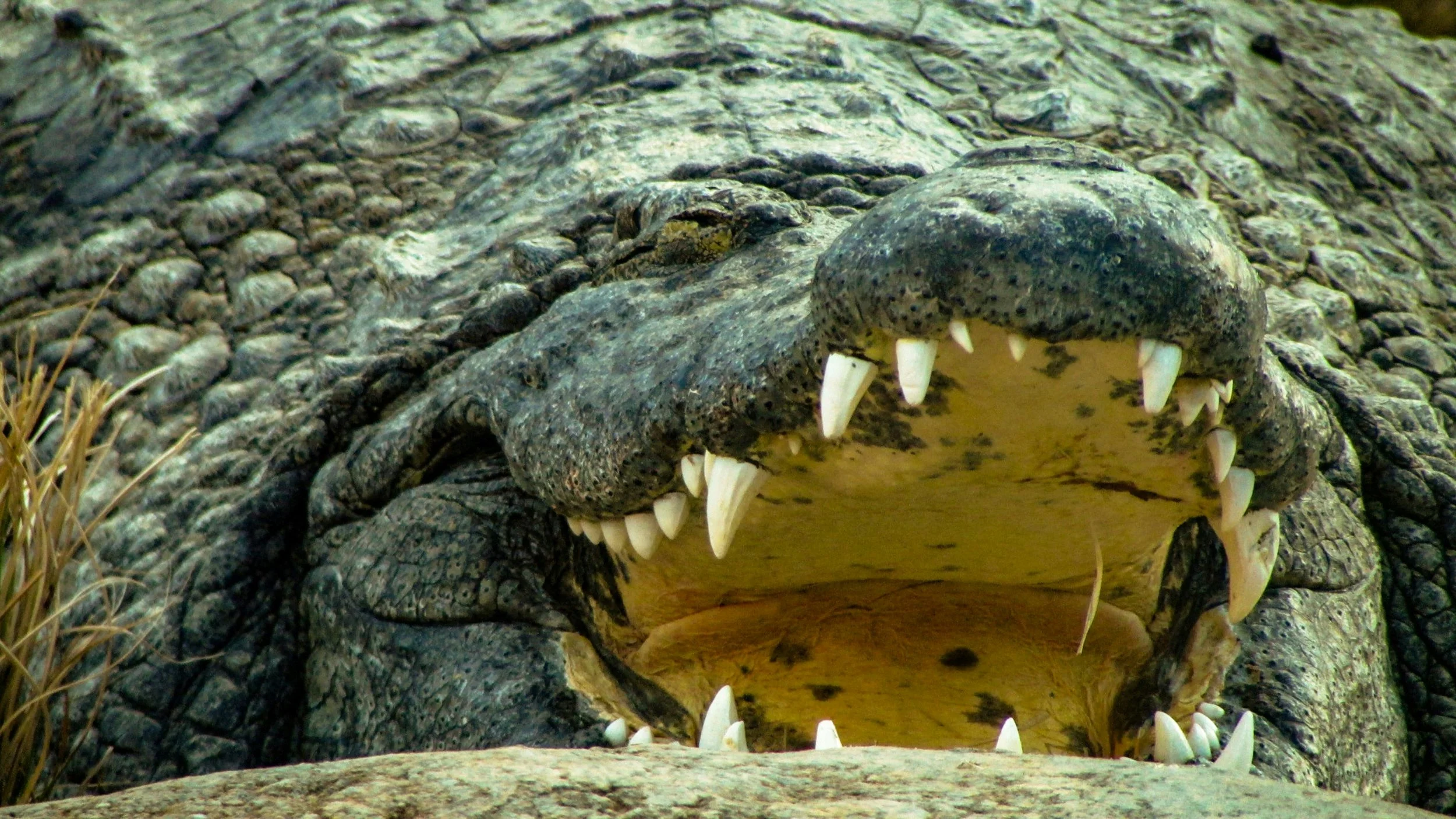
A close-up of a massive crocodilian jaw lined with sharp conical teeth, illustrating the terrifying bite mechanics of prehistoric river predators like Sarcosuchus. Known as the “supercroc,” Sarcosuchus dominated Cretaceous waterways with enormous jaws capable of ambushing dinosaurs and large prey at the water’s edge.
While Titanoboa reigned in waterlogged jungles, Sarcosuchus imperator dominated the rivers of early Cretaceous Africa, roughly 113 million years ago. Known colloquially as the “supercroc,” Sarcosuchus could reach lengths of 12 meters and exceed ten tons in mass (Strauss, 2025). Its formidable jaws, lined with backward-curving teeth, dragged prey into the water for drowning, a method reminiscent of modern crocodiles, but amplified by scale.
Fossil evidence situates Sarcosuchus in West African waterways alongside herbivorous dinosaurs such as Lurdusaurus and Ouranosaurus, and fish including ancient coelacanths (Rigby, 2021). Unlike modern crocodylians, Sarcosuchus continued growing throughout life, its osteoderm armor forming a nearly continuous shield across its back. Its long, flat snout specialized in piscivory, but adults likely had no qualms about attacking terrestrial dinosaurs that ventured too close.
Sarcosuchus was not a direct ancestor of modern crocodiles but a member of an extinct group known as pholidosaurids. Its evolution reveals the extraordinary diversity of Cretaceous rivers, where predators exploited every available niche, and where survival demanded both cunning and brute force.
🦂 5. Jaekelopterus — the giant sea scorpion
Imagine kneeling beside a freshwater lagoon. The water stirs; the massive claws of Jaekelopterus snap down with a speed and force no human can dodge. One grasp, and bones would shatter, the body torn and dragged beneath the murky waters. The prehistoric scorpion glides through its domain like a dark, armored specter of inevitability.
If Sarcosuchus ruled rivers, then Jaekelopterus rhenaniae commanded the freshwater and brackish waters of the Devonian, some 400 million years ago. This eurypterid, the largest known sea scorpion, reached lengths of 2.5 meters—or over 3.5 meters including its massive claws—towering above any modern arthropod (Gutierrez, 2016; Udurawane, n.d.).
Jaekelopterus was both alien and terrifying. Its segmented, armored body and enormous pincers allowed it to seize prey with precision, hunting fish and smaller arthropods. Fossil discoveries in the Rhineland, particularly the remarkable claw analyzed by Braddy and Poschmann, reveal a predator optimized for grasping, crushing, and dominating its aquatic environment. Unlike modern horseshoe crabs, its distant relatives, Jaekelopterus could actively pursue prey, a predator of cunning and strength (Britannica, n.d.).
In evolutionary terms, its gigantism reflects a period when oxygen levels and ecological pressures allowed invertebrates to reach extraordinary sizes. The dominance of Jaekelopterus ended only with the Permian Extinction, the most devastating event in Earth’s history. Nature’s ultimate hunters are still just passengers on a planet that doesn't care for their rank..
🐗 6. Andrewsarchus — the mammalian nightmare
Walking across the plains of Eocene Mongolia, a human senses movement, a towering skull emerges above tall grass. Andrewsarchus lunges, jaws powerful enough to crush bone. Even with speed, a human could not evade its calculated strike; the predator is opportunistic, adaptive, and merciless. One moment of inattention, one step too close, and survival ends.
Not all apex predators were reptiles or arthropods. Andrewsarchus mongoliensis, a mammal of enigmatic proportions, roamed what is now Inner Mongolia approximately 45 million years ago. Known from a single, near-meter-long skull discovered during Roy Chapman Andrews’ 1923 expedition, this species may have been the largest terrestrial carnivorous mammal ever recorded, standing six feet at the shoulder and stretching twelve feet from nose to tail (American Museum of Natural History, 2013).
Initially thought to be a wolf-like mesonychid, later studies place Andrewsarchus within the Artiodactyla, possibly related to early whales and hippos (Black, 2026). Its teeth were built for crushing, allowing it to consume a diet of carrion, smaller animals, and perhaps opportunistically, plants. Despite its size and power, Andrewsarchus exemplifies a different kind of deadliness: one defined not just by force, but by adaptability. It lived in a world unclaimed by modern carnivores, where ecological niches demanded ingenuity as much as strength.
Andrewsarchus, Titanoboa, and Jaekelopterus share a narrative thread: they are witnesses to a pre-human world in which gigantism, specialization, and environmental extremes shaped predators in ways that are almost unimaginable to us today.
Could humans survive in the prehistoric world?

Two hikers walk across a vast grassy landscape, illustrating human vulnerability in the wild and prompting the question of whether modern humans could survive in prehistoric ecosystems dominated by apex predators like Tyrannosaurus rex, Megalodon, and Titanoboa.
Before these giants, we are nothing but fragile spectators. Our species, born for cunning rather than brute force, is an anomaly in the evolutionary record. Compared to these monsters, humans are slow, weak, and unarmed.
Physical Disadvantages – No claws, fangs, or natural armor. Our teeth are small; our skin easily torn.
Lack of Speed – Even the fastest human sprinter would be outpaced by a T. rex’s 19 km/h stride or a Megalodon’s burst in water.
No Natural Weapons – Without tools, we rely entirely on intellect; any miscalculation is fatal.
Susceptibility to Pathogens – Ancient ecosystems teemed with microbes and parasites to which we have no immunity.
Even armed with modern tools, we would struggle. Evolution designed these predators for survival in landscapes untouched by human intervention.
Why ancient predators were so extreme
These monsters were products of extreme conditions.
Higher Oxygen Levels – The Carboniferous and Devonian periods allowed arthropods like Jaekelopterus to grow to monstrous sizes.
Evolutionary Arms Race – Prey and predator co-evolved in perpetual escalation: faster, stronger, deadlier.
No Human Interference – Predators evolved free from hunting pressures, unlike today’s megafauna.
Ecosystem Balance – Apex predators maintained population checks, shaping entire habitats.
These forces combined to produce organisms whose power and form are almost inconceivable today. Human intelligence, rather than physical dominance, is what allowed our species to navigate this perilous past.
The scariest truth — modern animals are still deadly
While prehistoric predators fascinate us, some modern animals are far from harmless. The Great White shark patrols ocean coasts; saltwater crocodiles dominate rivers and estuaries; polar bears stalk Arctic ice with lethal precision. Though smaller than their prehistoric counterparts, these species maintain the evolutionary edge that made their ancestors terrifying.

A powerful polar bear presses against ice above the water, revealing the raw predatory strength of one of the Arctic’s most dangerous animals and reminding us that even today’s wildlife can rival the lethality of prehistoric apex predators.
Prehistory teaches a humbling truth: the Earth has always hosted creatures far more powerful than we are. Our survival is owed to strategy, cooperation, and adaptability, not to natural superiority.
The age of monsters
Walking through the fossil record is to walk among giants. Tyrannosaurus rex, Megalodon, Titanoboa, Sarcosuchus, Jaekelopterus, Andrewsarchus: names that echo through deep time, names that summon awe and terror in equal measure. Evolution, in its unflinching creativity, produces extremes that dwarf human strength and imagination.
We survived not because we were strong, but because we learned, planned, and communicated. We are fragile in body but resilient in mind. The monsters of the past, once rulers of Earth’s forests, rivers, and seas, remind us of the precariousness of life and the extraordinary adaptations necessary for survival.
The age of monsters is past, but their legacy endures, in science, in imagination, and in the stark knowledge of our own vulnerability.
References
American Museum of Natural History. (2013). Andrewsarchus, "Superb Skull of a Gigantic Beast". https://www.amnh.org/explore/news-blogs/andrewsarchus-prehistoric-mammal
Black, R. (2026). This Giant Carnivore Ran on Hooves. Scientists Are Investigating Its Massive Skull and Crushing Teeth to Decipher the Beast’s True Nature. Smithsonian magazine. https://www.smithsonianmag.com/science-nature/this-giant-carnivore-ran-on-hooves-scientists-are-investigating-its-massive-skull-and-crushing-teeth-to-decipher-the-beasts-true-nature-180988212/
Bradford, A. (2021). Megalodon: Facts about the long-gone, giant shark. LiveScience. https://www.livescience.com/63361-megalodon-facts.html
Britannica. (n. d.). Jaekelopterus rhenaniae. https://www.britannica.com/animal/Jaekelopterus-rhenaniae
Davis, J. (2025). Megalodon: The truth about the largest shark that ever lived. Natural History Museum. https://www.nhm.ac.uk/discover/megalodon--the-truth-about-the-largest-shark-that-ever-lived.html
Geggel, L. (2024). Tyrannosaurus rex: Facts and photos of the dinosaur king. LiveScience. https://www.livescience.com/23868-tyrannosaurus-rex-facts.html
Gutierrez, B. (2016). Jaekelopterus. Prehistoric-Wildlife. https://www.prehistoric-wildlife.com/species/jaekelopterus/
Gugliotta, G. (2012). How Titanoboa, the 40-Foot-Long Snake, Was Found. Smithsonian magazine. https://www.smithsonianmag.com/science-nature/how-titanoboa-the-40-foot-long-snake-was-found-115791429/
McKeever, A. (n. d.). Why Tyrannosaurus rex was one of the fiercest predators of all time. National Geographic. https://www.nationalgeographic.com/animals/facts/tyrannosaurus-rex
Rigby, S. (2021). Sarcosuchus imperator: The 'super croc' that could have hunted dinosaurs. BBC Science Focus. https://www.sciencefocus.com/nature/sarcosuchus-imperator
Smithsonian Institute. (2014). Tyrannosaurus rex. https://www.si.edu/newsdesk/factsheets/tyrannosaurus-rex
Strauss, B. (2025). 10 Facts About Sarcosuchus, the World's Biggest Crocodile. ThoughtCo. https://www.thoughtco.com/facts-about-sarcosuchus-worlds-biggest-crocodile-1093333
Udurawane, V. (n. d.). Gigantic "scorpions" hunted in ancient seas. https://eartharchives.org/articles/gigantic-scorpions-hunted-in-ancient-seas/index.html
Yong, E. (2009). Titanoboa – thirteen metres, one tonne, largest snake ever. National Geographic. https://www.nationalgeographic.com/science/article/titanoboa-thirteen-metres-one-tonne-largest-snake-ever