What Ireland would look like in 2050 if we restored just 10% more native woodland
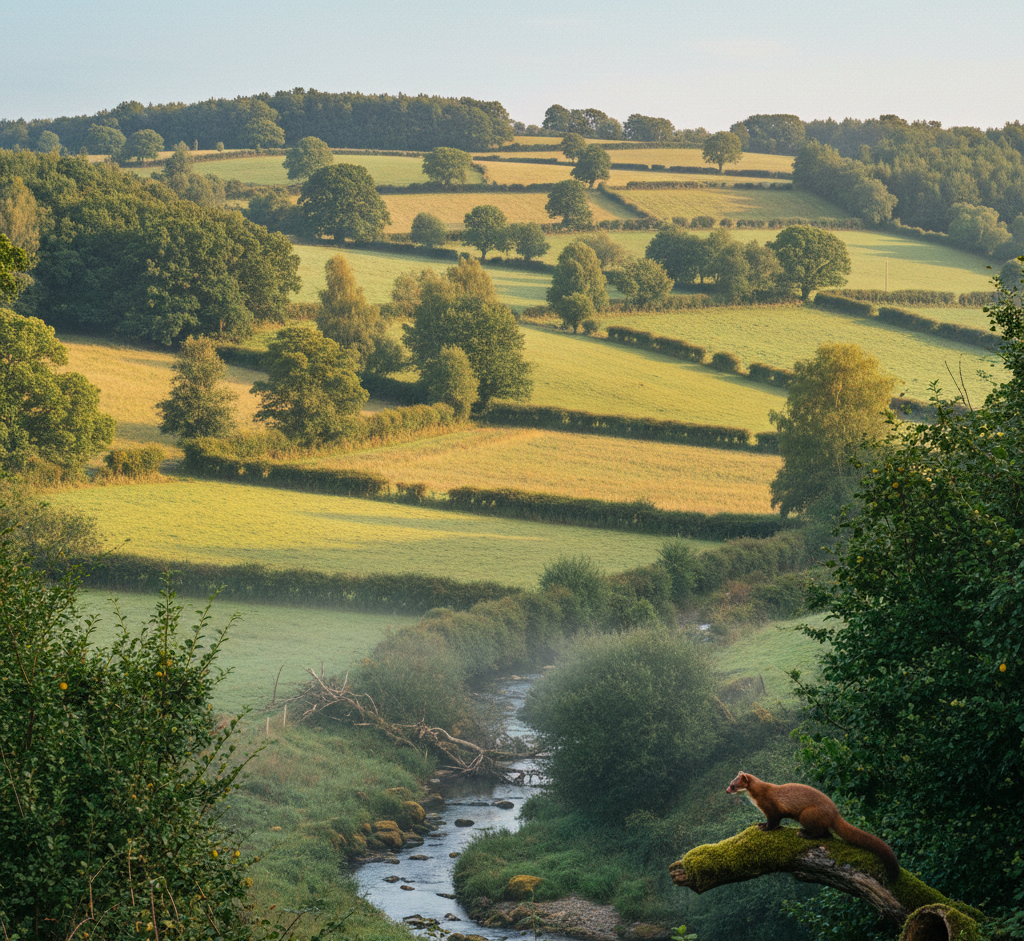
An Irish rural landscape showing expanded hedgerows, riparian woodland, and scattered native trees across farmland, illustrating how restoring native woodland could reconnect habitats, cool rivers, and support species like pine martens by 2050.
Ireland, 2050
It is May in 2050, and dawn arrives with a density of birdsong that feels almost orchestral. Not louder, exactly — but layered. Blackbird, robin, chiffchaff, wren. Sound carries differently now, travelling through corridors of oak and birch that thread between fields once held in uninterrupted grass. The wind, once unbroken across pasture, slows itself in leaf and branch.
Along the River Suir, alder roots clutch the bank in quiet architecture. The water runs cooler than it did a generation earlier, shaded through summer. Salmon move upriver with fewer thermal barriers. In the midlands, hedgerows have thickened into ribbons of woodland that link one farm to another, not replacing agriculture but stitching through it.
Pine martens move easily along these green passages. Red squirrels hold territories where once only grey shapes flickered. Hen harriers quarter over mosaic landscapes instead of vast uniform fields.
This is not fantasy. It is what current ecological modelling suggests would unfold if Ireland restored just 10% more native woodland by 2050 — a shift measurable in hectares, policy instruments, and planting rates, but experienced in shade, sound, and soil.
Ireland today
To understand what ten percent might change, we must first look plainly at what exists.
Ireland today has approximately 11–12% forest cover, according to the National Forest Inventory (2023). That figure, at first glance, suggests a modest woodland presence. Yet only about 2% of Ireland’s land area is covered by native woodland — oak, birch, ash, alder — ecosystems that evolved within the island’s ecological memory. The remainder consists largely of commercial plantations, dominated by non-native Sitka spruce, managed on short rotations and often ecologically simplified.
Across the European Union, average forest cover stands near 39%. Ireland therefore sits among the lowest in Europe for both overall forest cover and native woodland proportion. The island that once held vast temperate rainforest now carries fragments — ecological islands in a matrix of agricultural grassland.
Agriculture dominates approximately two-thirds of Ireland’s land use and accounts for roughly 37–38% of national greenhouse gas emissions, one of the highest agricultural emission shares in the EU. Grassland for beef and dairy production forms the defining texture of the rural landscape: open, windswept, productive — and largely monocultural.
Biodiversity metrics reflect this simplification. Farmland bird populations in Ireland have declined significantly over recent decades, mirroring broader European trends. Species dependent on mixed habitats — skylark, yellowhammer, lapwing — have shown marked decreases in abundance. Pollinator populations have also declined, with habitat loss and agricultural intensification cited among the primary drivers.
Water systems tell a similar story. EPA monitoring indicates that nutrient runoff — particularly nitrogen and phosphorus from agricultural sources — continues to affect river quality. Many water bodies fail to achieve “good ecological status” under EU Water Framework Directive standards. In open pasture landscapes, rainfall moves rapidly across compacted soils, contributing to sedimentation and episodic flooding downstream.
Ireland’s rivers are also warming. Climate change compounds land-use effects, as exposed channels receive full solar radiation. Cold-water species such as Atlantic salmon face increasing thermal stress, especially during summer low-flow periods.
This is not a narrative of collapse. Ireland remains greener than most of Europe, its hedgerow network dense by continental standards. Yet ecological resilience is thinly distributed. Native woodland persists in pockets — Killarney, parts of Wicklow, fragments in Clare — but connectivity is weak.
In 2025, Ireland is an agricultural landscape with woodland remnants. Its ecological challenge is not greening a desert, but restoring continuity to a broken pattern.
What does “10% more native woodland” actually mean?
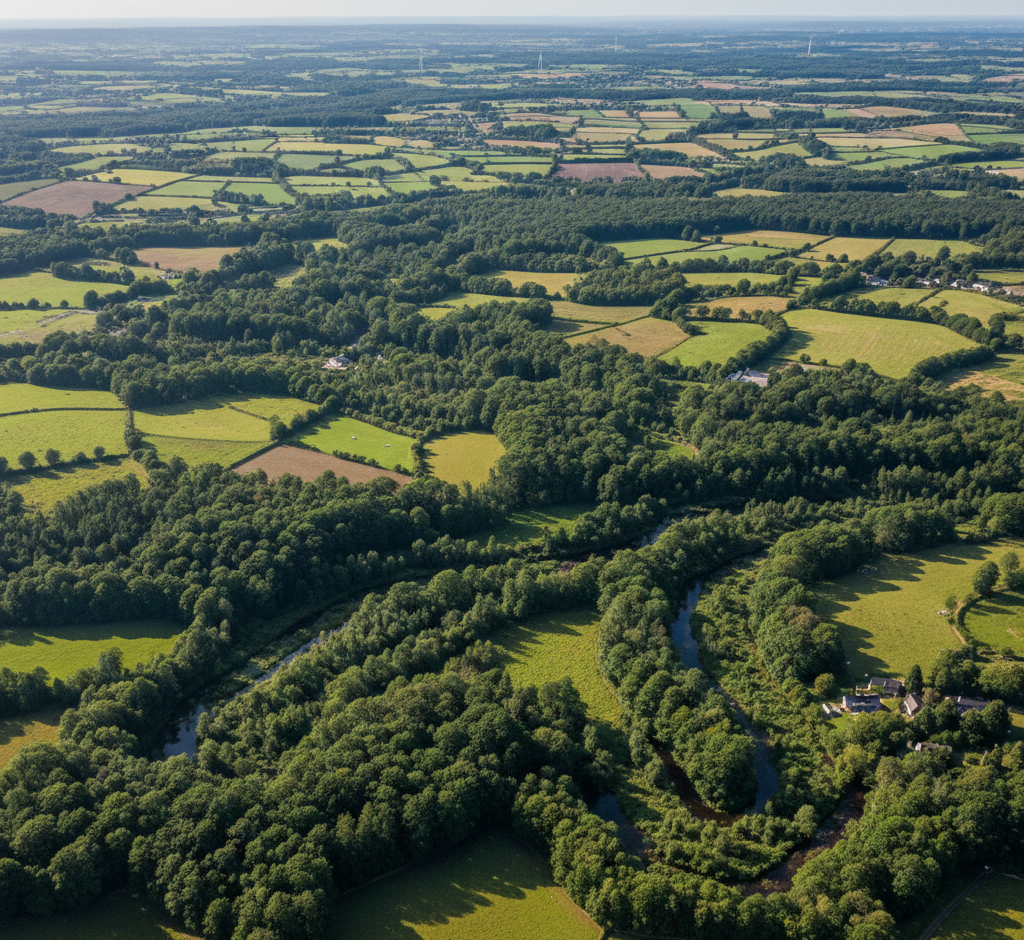
Drone view of Ireland’s patchwork farmland showing expanded native woodland blocks, hedgerow corridors, and riparian tree planting along a river — visualizing how increasing forest cover from 11% to 21% could reshape land use by 2050.
Numbers matter. Without them, restoration becomes a mood rather than a plan.
Ireland’s land area is approximately 6.9 million hectares. With current forest cover at roughly 11–12%, woodland occupies around 770,000–830,000 hectares. Native woodland, however, covers only about 2% of total land area — approximately 140,000 hectares.
When we speak of “10% more native woodland,” the most ecologically meaningful framing is not a 10% relative increase on the existing 2%, which would be modest. Instead, consider a rise in overall woodland cover from approximately 11% to 21% of land area by 2050, with the majority of new planting composed of native species.
That would require afforesting roughly 690,000 additional hectares over 25 years — an average increase of about 27,600 hectares annually, or roughly 0.4% of national land area per year.
Is this plausible?
Historically, Ireland’s afforestation rates in the late 20th century exceeded 20,000 hectares annually during peak planting years. Comparable EU countries have sustained similar or higher annual increases during national restoration drives. Achieving 27,000 hectares per year would be ambitious, but not outside historical precedent — particularly if policy incentives, carbon markets, and EU biodiversity funding align.
Where would this land come from?
Not from wholesale abandonment of productive dairy land. Rather, primarily from:
Marginal or low-yield pasture
Riparian buffer zones along rivers and streams
Peatland edge areas unsuitable for intensive grazing
Shelterbelt expansion and agroforestry integration
The shift would not be uniform. It would be patterned: corridors, clusters, belts, expansions of existing fragments.
Twenty-five years is one generation of woodland growth. Young native forests establish canopy structure within decades. By 2050, much of this woodland would be in early to mid-successional stages — dynamic, carbon-hungry, biologically active.
The key point is this: ten percent is not an abstract aspiration. It is a measurable land-use reallocation within known ecological and policy constraints.
Ecological cascades
A. Biodiversity recovery (probability: high)
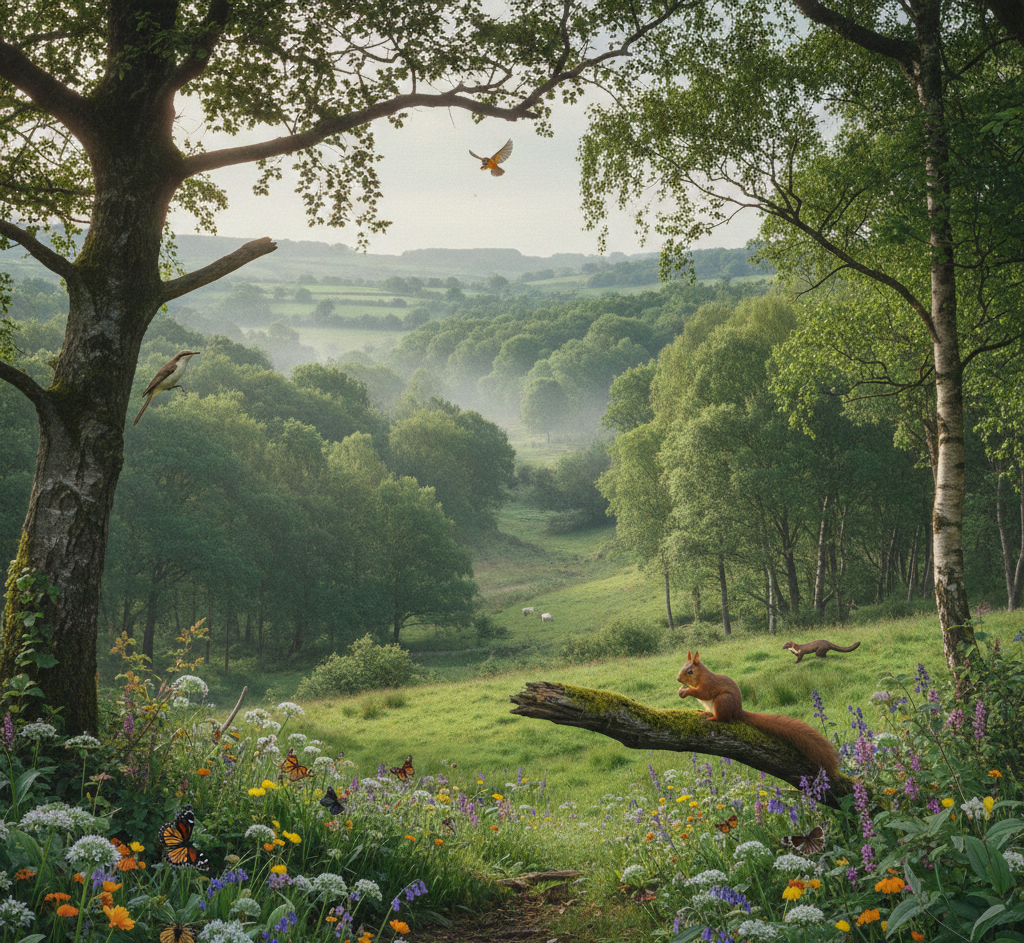
A species-rich native woodland scene in Ireland showing layered habitats — flowering plants, pollinators, birds, and mammals — illustrating how expanding native woodland triggers ecological cascades and biodiversity recovery.
Ecology operates on thresholds.
The species–area relationship — one of the most robust findings in ecological science — shows that as habitat area increases, species richness rises non-linearly. Doubling habitat does not simply double species; it often increases richness disproportionately because extinction risk declines and specialist niches reappear.
Expanding native woodland from 2% to something approaching 10–15% of total land area would dramatically increase contiguous habitat size. Woodland corridors would reduce fragmentation, allowing dispersal between currently isolated populations.
Meta-analyses across temperate Europe consistently show that native broadleaf woodland supports higher insect biomass and diversity than monoculture plantation forestry or open pasture. Increased insect biomass forms the base of trophic pyramids — supporting birds, bats, and small mammals.
Ireland already holds pine marten populations that have rebounded in recent decades. Where pine martens increase, grey squirrel numbers decline, creating competitive space for native red squirrels. Habitat connectivity would likely accelerate this dynamic.
Woodland bird assemblages — treecreeper, wood warbler, redstart — could expand beyond current strongholds if sufficient habitat corridors emerge. Farmland bird decline may stabilize where mosaic landscapes replace uniform grassland.
Pollinators benefit from structural complexity. Native woodland edges provide flowering understory species, nesting substrates, and seasonally varied forage. While woodland does not replace species-rich meadow, its integration into agricultural matrices increases heterogeneity — a key predictor of biodiversity resilience.
The probability of measurable biodiversity increase under a 10% woodland expansion scenario is high, based on European rewilding case studies and habitat restoration meta-reviews (Menéndez-Miguélez et al., 2024; Selwyn et al., 2025; Marcantonio et al., 2025; Crouzeilles et al., 2016).
B. Carbon Sequestration (probability: high, quantifiable)
Temperate broadleaf woodland sequesters approximately 4–8 tonnes of CO₂ per hectare per year during active growth phases, depending on species composition, soil type, and age.
If Ireland restored 690,000 hectares of predominantly native woodland, and if average sequestration over the first decades reached even 5 tonnes CO₂ per hectare annually, this would equate to roughly 3.45 million tonnes of CO₂ absorbed per year once establishment stabilised.
Ireland’s total annual greenhouse gas emissions currently exceed 55 million tonnes CO₂ equivalent. Agricultural emissions account for roughly 20–22 million tonnes of that total.
Thus, expanded native woodland would not render Ireland carbon neutral. But it could offset a meaningful fraction — potentially 15% or more of agricultural emissions over time — particularly when combined with soil carbon gains and reduced peat degradation.
Young woodland sequesters carbon most rapidly. By 2050, much of the newly planted forest would still be in peak uptake phases.
The carbon story is not salvation. It is mitigation — measurable, cumulative, and compounding.
C. Water systems & flood mitigation (probability: moderate to high)
Tree roots increase soil porosity. Leaf litter builds organic matter. Woodland floors absorb rainfall differently than grazed pasture, slowing surface runoff.
Riparian woodland buffers — strips of native trees planted along waterways — reduce nitrogen and phosphorus leaching by intercepting overland flow and enhancing microbial uptake. Evidence from UK and European catchment studies shows significant nutrient reductions where riparian planting is implemented strategically.
Shade from riverside woodland lowers peak summer water temperatures. For cold-water fish species such as Atlantic salmon, even reductions of 1–2°C can influence survival and migration timing.
Flood mitigation is more complex. Woodland does not prevent large-scale flood events caused by extreme rainfall, but it can reduce flash flooding by slowing water movement through catchments.
By 2050, under expanded woodland coverage, we would likely see:
Cooler river stretches
Improved water clarity in afforested catchments
Reduced nutrient spikes following heavy rain
These are moderate-to-high probability outcomes, grounded in hydrological modelling rather than romantic speculation.
D. Soil & microclimate (probability: high)
Ireland is a windy island.
Open pasture exposes soil to wind erosion, compaction, and moisture fluctuation. Woodland reduces wind speed at ground level, creating microclimates that stabilize temperature and humidity.
Leaf litter contributes to soil carbon accumulation. Mycorrhizal fungal networks — symbiotic associations between fungi and plant roots — expand beneath native woodland, enhancing nutrient cycling and drought resilience.
As climate change increases variability in rainfall patterns, microclimate buffering becomes more significant. Woodland belts can reduce evapotranspiration stress in adjacent fields, improving grass productivity in some agroforestry systems.
The soil beneath woodland becomes darker, richer, more structured. Carbon moves from atmosphere to root to earth.
Probability here is high because these processes are mechanistic and well-documented (Fahad et al., 2022; Ntiyakunze & Stage, 2024; Enescu et al., 2025).
The agricultural landscape in 2050
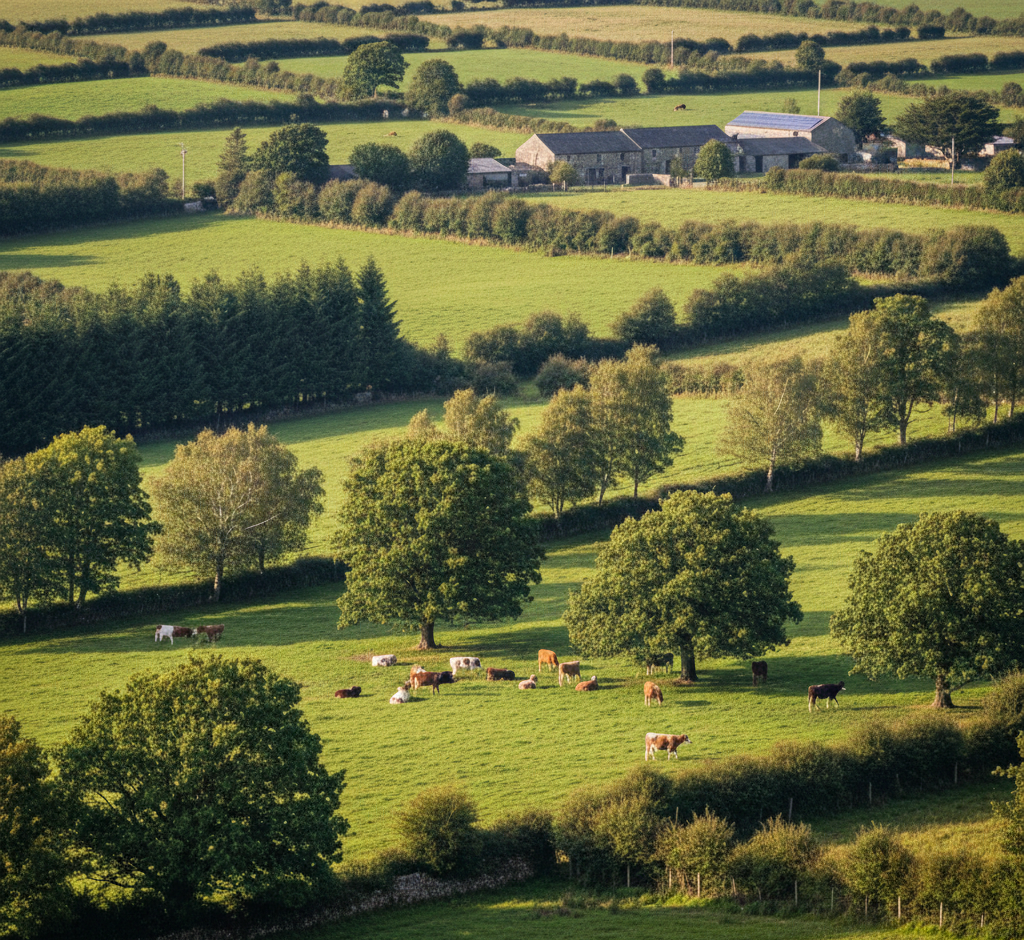
A pastoral Irish farm landscape showing cows resting under mature trees, dense hedgerows connecting fields, and woodland belts integrated into agriculture — representing how restoring 10% more native forest could reshape Ireland’s rural environment by 2050.
The question comes quickly: what happens to food?
Ireland’s rural identity is deeply tied to beef and dairy. Any woodland expansion must therefore engage with economic reality, not ecological nostalgia.
But a 10% increase in native woodland does not mean a 10% drop in production.
Much of the land most suitable for afforestation is marginal pasture — low-yield, runoff-prone, or climatically exposed. Teagasc (2025) data shows productivity is unevenly distributed; targeting less efficient land reduces trade-offs.
Woodland need not replace farming entirely. Agroforestry — integrating trees into grazing systems — can be productivity-neutral or even beneficial. Shelterbelts reduce wind stress on livestock. Shade mitigates summer heat. Roots improve soil structure and drainage.
By 2050, farmland under this scenario would look less uniform: alder along streams, oak breaking wind across uplands, scattered trees within pasture. Food production would continue. The texture would change.
Diversification may follow — timber, coppice, nuts, honey, small-scale woodland enterprise — not replacing agriculture, but buffering it against climate and market volatility.
Trade-offs remain. Some expansion targets would tighten. Transition requires policy stability. Yet with planning, resilience could increase rather than decline.
Farms would not vanish beneath forest. They would become layered — still productive, but ecologically interwoven.
Human & cultural effects
Restoration transcends the purely ecological; it is an act of reshaping how we perceive the world.
Studies across Europe consistently show that proximity to woodland correlates with improved mental health outcomes: lower reported stress, improved mood regulation, and increased physical activity. Access to green space is not a luxury variable; it is a public health determinant.
By 2050, children growing up in rural and peri-urban Ireland under expanded woodland cover would likely know native trees not as distant remnants but as familiar presences. Oak and birch would not belong solely to protected reserves but to walking routes, school grounds, and farm boundaries.
Recreation patterns would shift subtly. More local woodland trails. More birdwatching. Increased domestic tourism tied to seasonal change — bluebell springs, autumn fungi, winter canopy walks.
Ecological grief — the quiet sorrow associated with biodiversity loss — might ease where recovery becomes visible. Seeing pine martens return, hearing wood warblers expand their range, watching rivers run clearer — these are not abstract metrics but embodied experiences.
Cultural memory would also shift. Ireland’s deep history includes temperate rainforest, oak forest, hazel woodland once covering much of the island. Restoration does not recreate the past, but it reconnects with it.
Human identity adapts to landscape. A more wooded Ireland would slowly reframe what rural normality looks like.
Risks, constraints & uncertainty
No ecological projection is without friction.
Landowner resistance remains a significant constraint. Afforestation requires long-term land-use change, and generational farms do not easily pivot without economic security. Policy instability — shifting subsidy structures, changing government priorities — could disrupt continuity over a 25-year horizon.
Poorly managed plantations pose another risk. If native woodland expansion were replaced in practice by monoculture planting driven solely by carbon credit markets, biodiversity gains would diminish. Species selection matters. Structural diversity matters.
Climate change introduces uncertainty. Some native species may struggle under altered temperature and rainfall regimes by mid-century. Ash dieback already demonstrates how disease can reshape woodland composition rapidly. Invasive species — both plant and animal — may exploit transitional habitats.
Carbon sequestration rates vary depending on soil type, establishment success, and management. Hydrological benefits depend on strategic placement, not random planting.
The probability of partial implementation is high. The probability of perfect implementation is low.
Yet uncertainty does not negate feasibility. It defines the need for adaptive management, monitoring, and policy coherence.
Returning to 2050
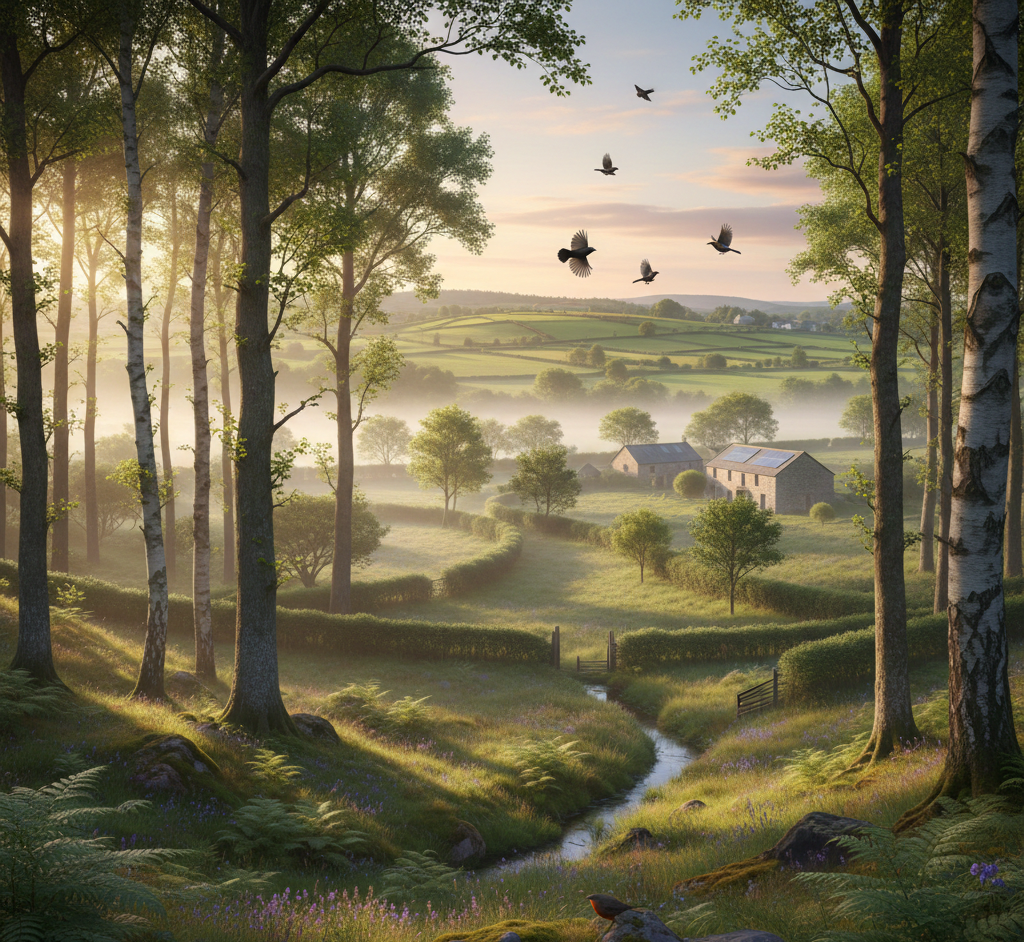
A restored Irish landscape in 2050 where native woodland corridors frame regenerative farmland at sunrise. Oak and birch trees rise along a shaded stream, birds move across layered canopies, and hedgerows connect farms into a living ecological network. This image illustrates how restoring 10% more native woodland in Ireland could enhance biodiversity, cool rivers, support pollinators, and build climate resilience while preserving agricultural productivity.
Stand again at that May dawn.
The birds are not new arrivals but populations expanding as habitat area and connectivity increase. Corridors turn fragments into living networks. From hill and roadside, the island appears greener — not in colour alone, but in depth: layered treetops, thickened hedgerow, shadow where there was once glare. Farms remain, their edges softened by oak and alder, by understory and leaf-fall. Rivers run clearer not because rainfall has changed, but because roots slow runoff, soils filter nutrients, and riparian shade cools the current. What grows is not only woodland, but the land’s capacity to hold life.
The wind still moves across Ireland — it always will — but it now meets resistance in leaf and branch. Soil holds more carbon than it did in 2025. Salmon move through stretches of river that remain within thermal tolerance. Pollinators navigate landscapes with more refuge.
Ireland in 2050 under this scenario is not transformed into wilderness. It is still agricultural, still inhabited, still economically active. But its proportions have shifted toward resilience.
Ten percent more native woodland does not solve climate change. It does not erase biodiversity decline entirely. It does not return Ireland to pre-colonial forest cover.
It recalibrates.
It moves the island from ecological scarcity toward ecological sufficiency. From fragmentation toward connection. From exposed systems toward buffered ones.
Ten percent is not a revolution.
It is a structural correction — measurable in hectares, audible in birdsong, visible in shade.
And perhaps, by 2050, ordinary enough that we forget how radical it once sounded.
References
Crouzeilles, R., Curran, M., Ferreira, M. S., Lindenmayer, D. B., Grelle, C. E. V., & Rey Benayas, J. M. (2016). A global meta-analysis on the ecological drivers of forest restoration success. Nature Communications 7, 11666. DOI: https://doi.org/10.1038/ncomms11666
Department of Agriculture, Food and the Marine. (2023). Broadleaf forests expand to cover nearly one third of estate: Ireland’s fourth National Forest Inventory published. https://www.gov.ie/en/department-of-agriculture-food-and-the-marine/press-releases/broadleaf-forests-expand-to-cover-nearly-one-third-of-estate-irelands-fourth-national-forest-inventory-published/
Enescu, C. M., Mihalache, M., Ilie, L., Dinca, L., Constandache, C., & Murariu, G. (2025). Agricultural Benefits of Shelterbelts and Windbreaks: A Bibliometric Analysis. Agriculture, 15(11), 1204. DOI: https://doi.org/10.3390/agriculture15111204
Fahad, S., Chavan, S. B., Chichaghare, A. R., Uthappa, A. R., Kumar, M., Kakade, V., Pradhan, A., Jinger, D., Rawale, G., Yadav, D. K., Kumar, V., Farooq, T. H., Ali, B., Sawant, A. V., Saud, S., Chen, S., & Poczai, P. (2022). Agroforestry Systems for Soil Health Improvement and Maintenance. Sustainability, 14(22), 14877. DOI: https://doi.org/10.3390/su142214877
Marcantonio, M., Strona, G., Sedano, F. et al. (2025). Simulating small woody feature restoration to enhance habitat connectivity in intensively farmed areas of the European Union. Landsc Ecol 40, 8. DOI: https://doi.org/10.1007/s10980-024-02001-z
Menéndez-Miguélez, M., Rubio-Cuadrado, Á., Cañellas, I., Erdozain, M., de Miguel, S., Lapin, K., Hoffmann, J., Werden, L., & Alberdi, I. (2024). How to measure outcomes in forest restoration? A European review of success and failure indicators. Front. For. Glob. Change, 08 October, 2024. Sec. Forest Management. Volume 7. DOI: https://doi.org/10.3389/ffgc.2024.1420127
Ntiyakunze, M. S. & Stage, J. (2024). The linkage between forests and household food security: Empirical evidence from Shinyanga Region, Tanzania, Trees, Forests and People. Volume 18, 100685, ISSN 2666-7193. DOI: https://doi.org/10.1016/j.tfp.2024.100685.
Selwyn, M., Lázaro-González, A., Lloret, F., Rey Benayas, J. M., Hampe, A., Brotons, L., Pino, J., & Espelta, J. M. (2025). Quantifying the impacts of rewilding on ecosystem resilience to disturbances: A global meta-analysis. Journal of Environmental Management, Volume 375, 124360, ISSN 0301-479. DOI: https://doi.org/10.1016/j.jenvman.2025.124360.
Teagasc. (2025). Map: Land prices by county. Agriculture and Food Development Authority. https://teagasc.ie/news--events/daily/map-land-prices-by-county/