Are zoos still necessary? The truth about zoos and wildlife conservation
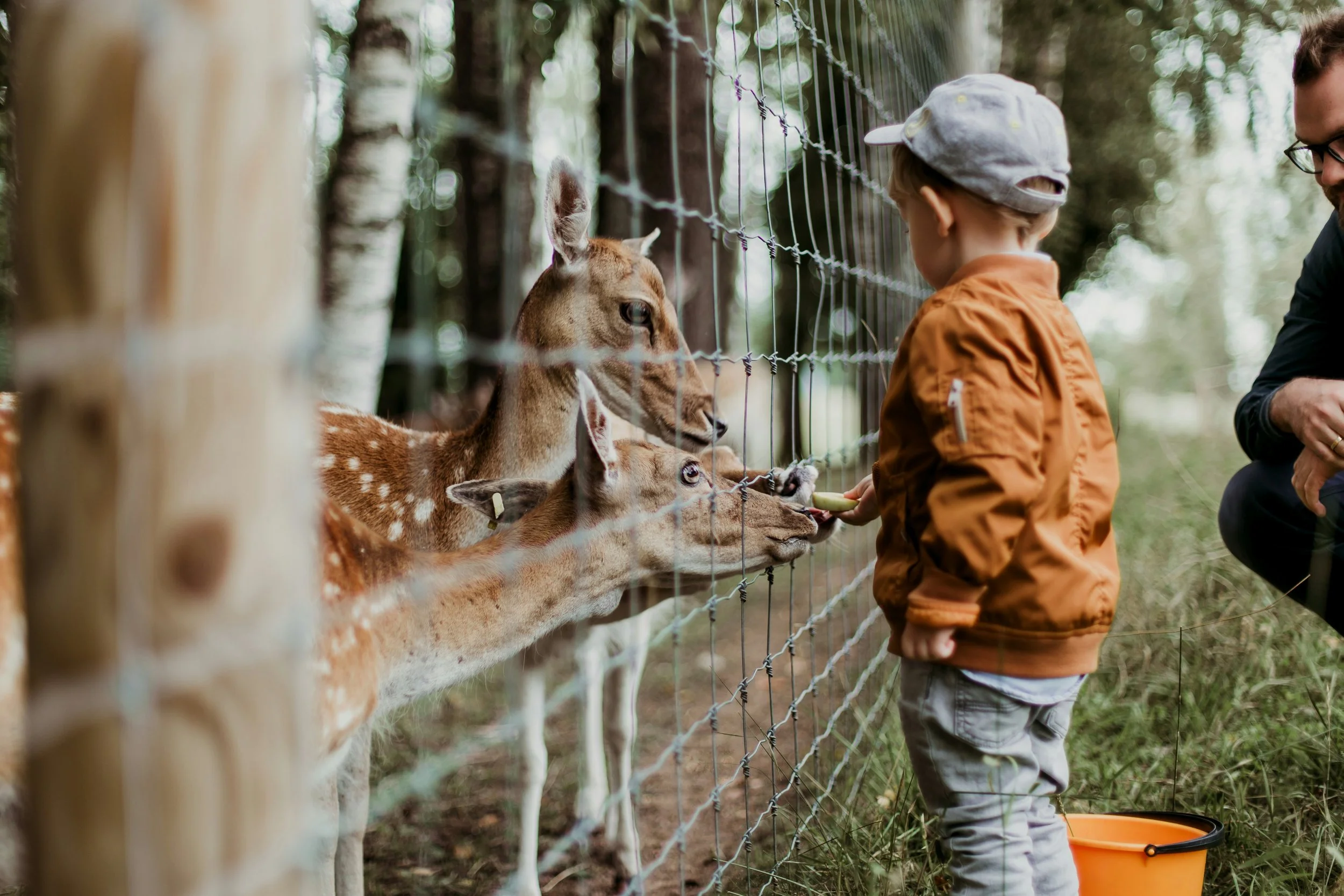
A young child feeds a deer through a wire fence in a controlled zoo-like environment, highlighting the close interaction between humans and captive wildlife. The image reflects one of the central tensions in modern zoos—balancing education and connection with animals against the ethical concerns of confinement and artificial habitats.
Why this question matters more than ever
Are zoos still necessary in 2026, or are they remnants of a past we have yet to outgrow?
It’s a question that now demands an answer. It presses itself into public consciousness, carried by images of pacing animals, conservation campaigns, and a growing awareness of the extinction crisis. Today, more than 16,000 species face extinction, with rates rising up to 10,000 times above natural levels, as noted by Tsui (2023). Against this backdrop of accelerating biodiversity loss and habitat destruction, zoos position themselves as sanctuaries, laboratories, and classrooms.
Yet the contradiction remains.
Zoos promise protection, but rely on captivity. They educate, yet entertain. They conserve species, while confining individuals.
This article does not offer a simple answer. Instead, it traces the long arc of zoos, from ancient power displays to modern conservation institutions, while examining the scientific evidence, ethical tensions, and uncertain future that define them today.
The original purpose of zoos
To understand whether zoos are still necessary, we must begin far earlier than glass enclosures and conservation signage—back to a time when animals were not protected, but possessed.
According to National Geographic (n. d.) and Britannica (2026), the history of zoos stretches over 4,000 years. In ancient Egypt and Mesopotamia, rulers assembled collections of exotic animals—menageries—not for science, but for spectacle and status. These early enclosures were declarations of dominance: over nature, over distance, over life itself.
Animals were captured, transported, displayed.
Nothing more was required of them.
It was not until the Enlightenment in the 18th century that a subtle shift began. Zoos transformed into sites of observation, where scientists attempted—however imperfectly—to study and categorize living beings. The opening of the Paris menagerie in 1793 marked a turning point: private collections became public institutions.
Still, the environments remained artificial, constrained, incomplete.
By the late 19th century, as described by Parks (2025), conditions in major cities like London and New York were stark—small cages, sterile surroundings, minimal regard for animal welfare. Into this landscape stepped Carl Hagenbeck, whose innovations would reshape the modern zoo. In 1907, he introduced open enclosures designed to mimic natural habitats, replacing bars with moats and illusion.
It was a revolution in design.
And yet, it carried a shadow. Before applying these ideas to animals, Hagenbeck had exhibited human beings—indigenous communities placed in reconstructed “habitats” for Western audiences. Between 20,000 and 25,000 people were displayed in such “human zoos,” reinforcing colonial hierarchies and racial ideologies.
The legacy is difficult to ignore.
Modern zoos, then, are not simply scientific institutions. They are the product of centuries of shifting values—power, curiosity, exploitation, and, more recently, conservation.
They did not begin with care.
They evolved toward it.
The conservation argument: do zoos actually help?
If zoos are to justify their existence in 2026, they do so here—within the language of conservation. Not spectacle, not curiosity, but survival.
The claim is clear: zoos help prevent extinction.
And in some cases, this is true.
Captive breeding programs
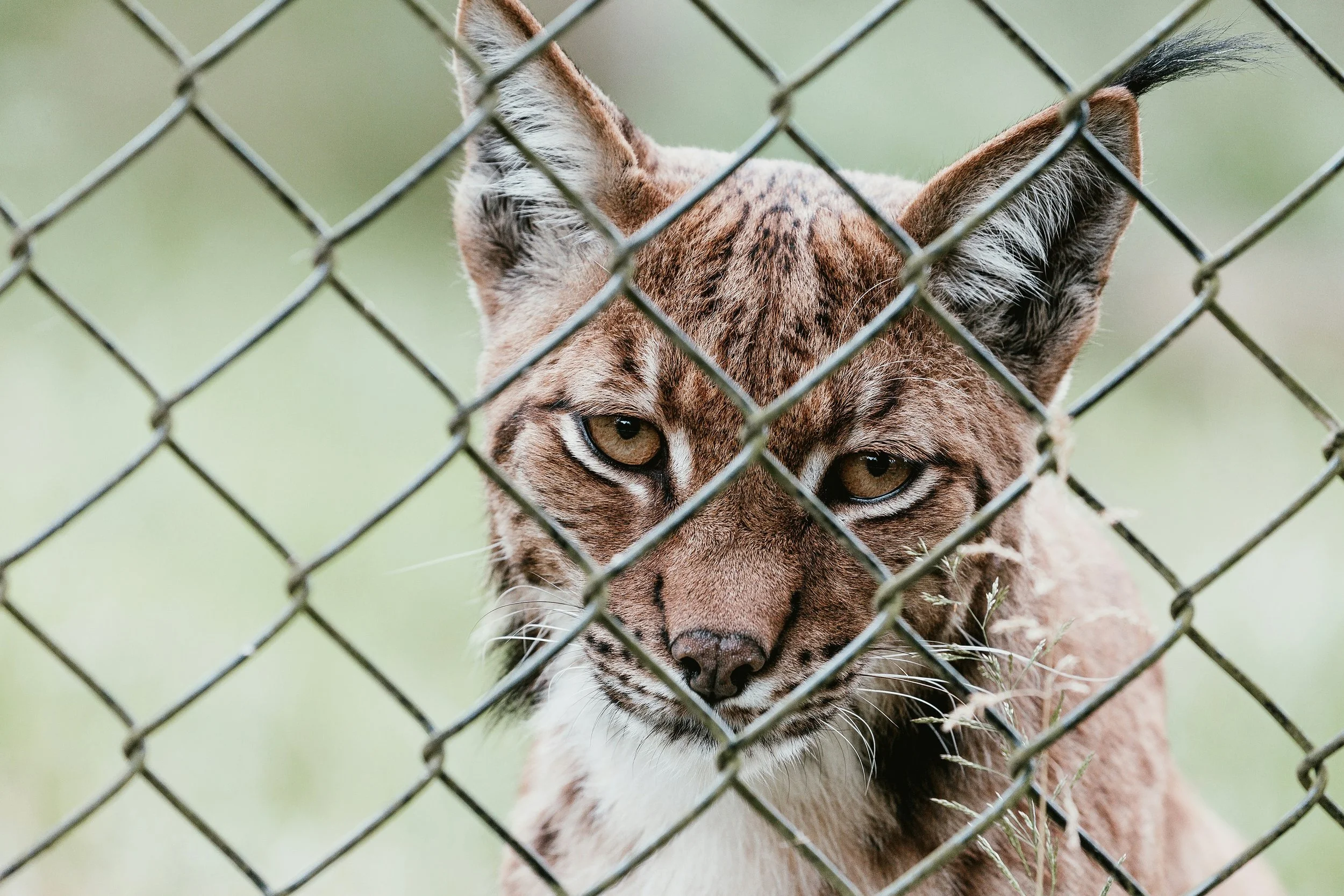
A close-up of a lynx seen through a wire fence in a zoo enclosure, its steady gaze framed by the barriers of captivity. The image captures the complex reality of captive breeding programs—where endangered species are protected and populations are sustained, yet individuals remain confined within artificial environments.
At the center of modern zoo conservation lies captive breeding of endangered species—a practice designed to hold a species at the edge of disappearance and pull it, slowly, back.
According to Waples (2007) and Pipes & Gonzalez Moreno (2024), these programs follow a structured path: a careful selection of founding individuals, the expansion of a genetically managed population, and, eventually, the possibility of reintroduction into the wild. In the short term, the results are often promising. Genetic diversity can be preserved. Numbers can recover.
Tsui (2023) points to species such as the Arabian oryx, the California condor, and the black-footed ferret—names that once hovered near extinction, now partially restored through coordinated breeding efforts across institutions.
But recovery, here, is fragile.
Because survival in captivity does not guarantee survival in the wild.
Over time, animals raised in controlled environments may undergo behavioral and genetic shifts—a subtle domestication that weakens their ability to hunt, evade predators, or reproduce independently. And even when individuals are ready to return, the world they left behind may no longer exist. Habitat loss remains the primary driver of extinction, a force that breeding programs alone cannot reverse.
Captive breeding, then, is not a solution.
It is a pause.
A way of holding life in suspension while the conditions for its return are rebuilt—or not.
Education and public awareness
Zoos also argue that they protect wildlife not only through biology, but through belief.
Each year, millions of visitors pass through zoo gates. Britannica (2026) estimates over 209 million annually. The premise is simple: exposure leads to empathy; empathy leads to action.
A child stands before a glass enclosure and sees, perhaps for the first time, the living presence of another species—not as an image, but as a body. Breathing. Watching. Existing.
From this encounter, zoos hope to cultivate awareness of animal welfare, of biodiversity loss, of the fragile systems that sustain life.
Beer, Shrader, Schmidt, and Yates (2023) describe zoos as educational platforms—spaces where scientific knowledge and public engagement intersect. Through exhibits, research, and storytelling, they aim to bridge the distance between human lives and ecological realities.
And yet, the impact is uncertain.
As noted by Britannica (2026), there is no conclusive evidence that zoo visits produce lasting changes in attitudes or behaviors toward conservation. The experience may inform—but does it transform?
The question lingers, unresolved.
Funding for wildlife protection
Beyond breeding and education, zoos contribute in a different way: through money.
Modern zoos often support zoo conservation programs that extend far beyond their physical boundaries. According to Beer et al. (2023), many institutions invest in in-situ conservation—funding habitat restoration, wildlife monitoring, and anti-poaching initiatives in natural ecosystems.
This dual approach—ex situ (within zoos) and in-situ (in the wild)—positions zoos as nodes within a global conservation network. Animals in enclosures become ambassadors for landscapes thousands of miles away, their presence helping to generate financial and political support.
But even here, the balance is delicate.
Spash (2022) warns of a broader shift within conservation itself—the transformation of nature into measurable, marketable assets. In this framework, biodiversity becomes “capital,” and protection becomes entangled with economic systems that may, paradoxically, drive environmental harm.
Zoos operate within this tension.
They raise funds to protect ecosystems.
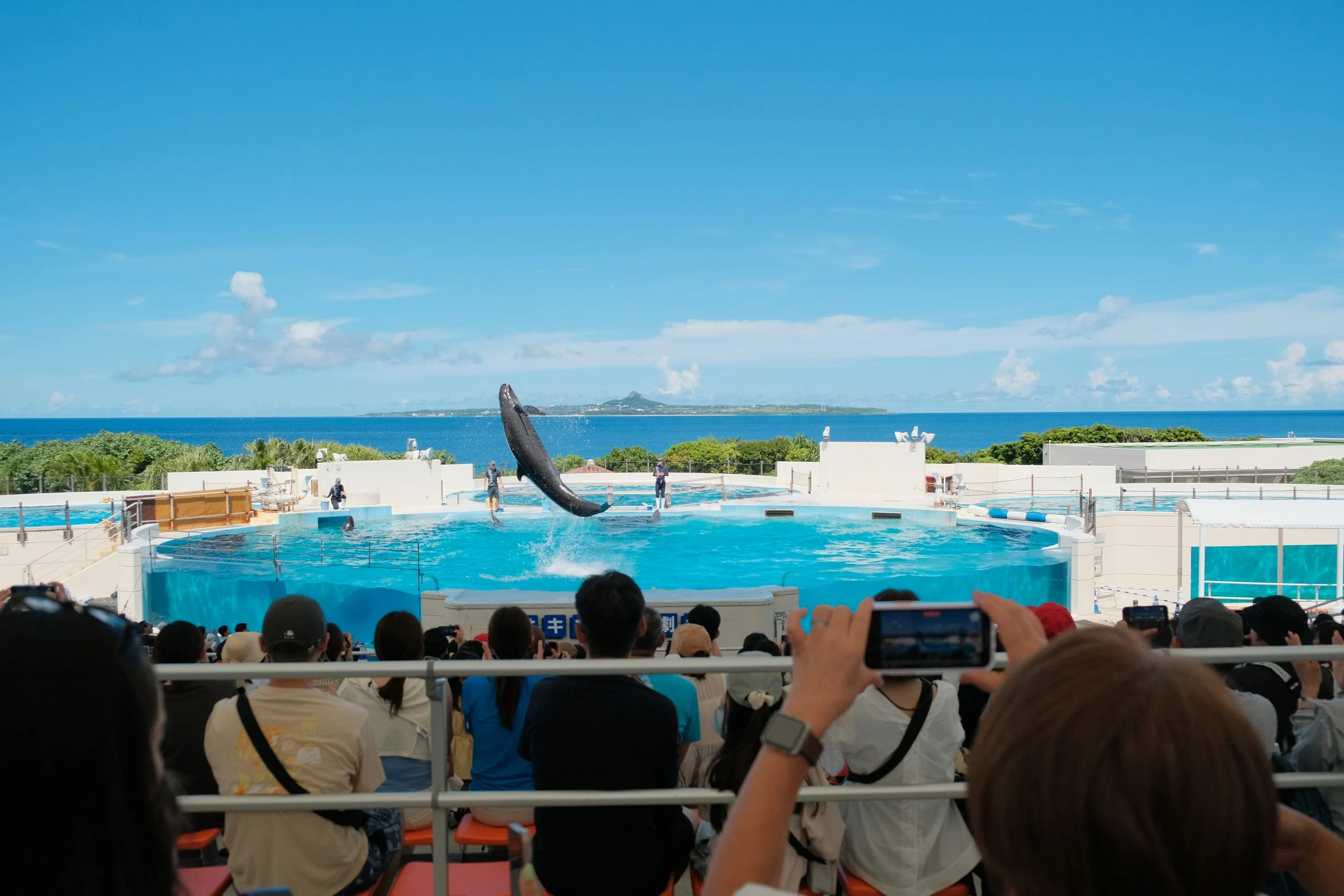
An orca leaps from the water during a live performance in a marine park, watched by a large audience capturing the moment on their phones. The image reflects the role of entertainment in generating revenue for zoos and marine parks, which is often used to support wildlife conservation programs and habitat protection efforts. At the same time, it underscores the ethical tension between spectacle and conservation—where funding for endangered species protection is intertwined with the captivity and performance of highly intelligent marine animals.
Yet they are also part of a world that continues to destroy them.
In the end, the conservation argument is neither false nor complete.
Zoos do help. Sometimes decisively, sometimes marginally.
But they do not solve the deeper crisis.
They stand, instead, as intermediaries: holding fragments of life in controlled spaces, while the wider world determines whether those fragments will ever be whole again.
The ethical debate: animal welfare concerns
If conservation is the justification, ethics is the reckoning.
Because behind every success story—every species stabilized, every population restored—there is an individual animal living a life that was never meant to unfold within boundaries.
Psychological impact on animals
Captivity does not simply change where an animal lives. It changes how it thinks, how it feels, how it exists.
Goldstein (2024) documents profound neurological and behavioral effects in mammals kept in confinement. Deprived of natural stimuli, social structures, and movement, animals often develop stereotypic behaviors—repetitive, purposeless actions such as pacing, swaying, or self-harm. These are not quirks. They are signals.
Indicators of a system under strain.
At the level of the brain, the changes run deeper: reduced neural connectivity, altered stress responses, disruptions in memory and emotional regulation. Chronic stress reshapes the architecture of the mind itself, affecting regions like the hippocampus and amygdala—structures essential for learning and survival.
Over time, instinct begins to erode.
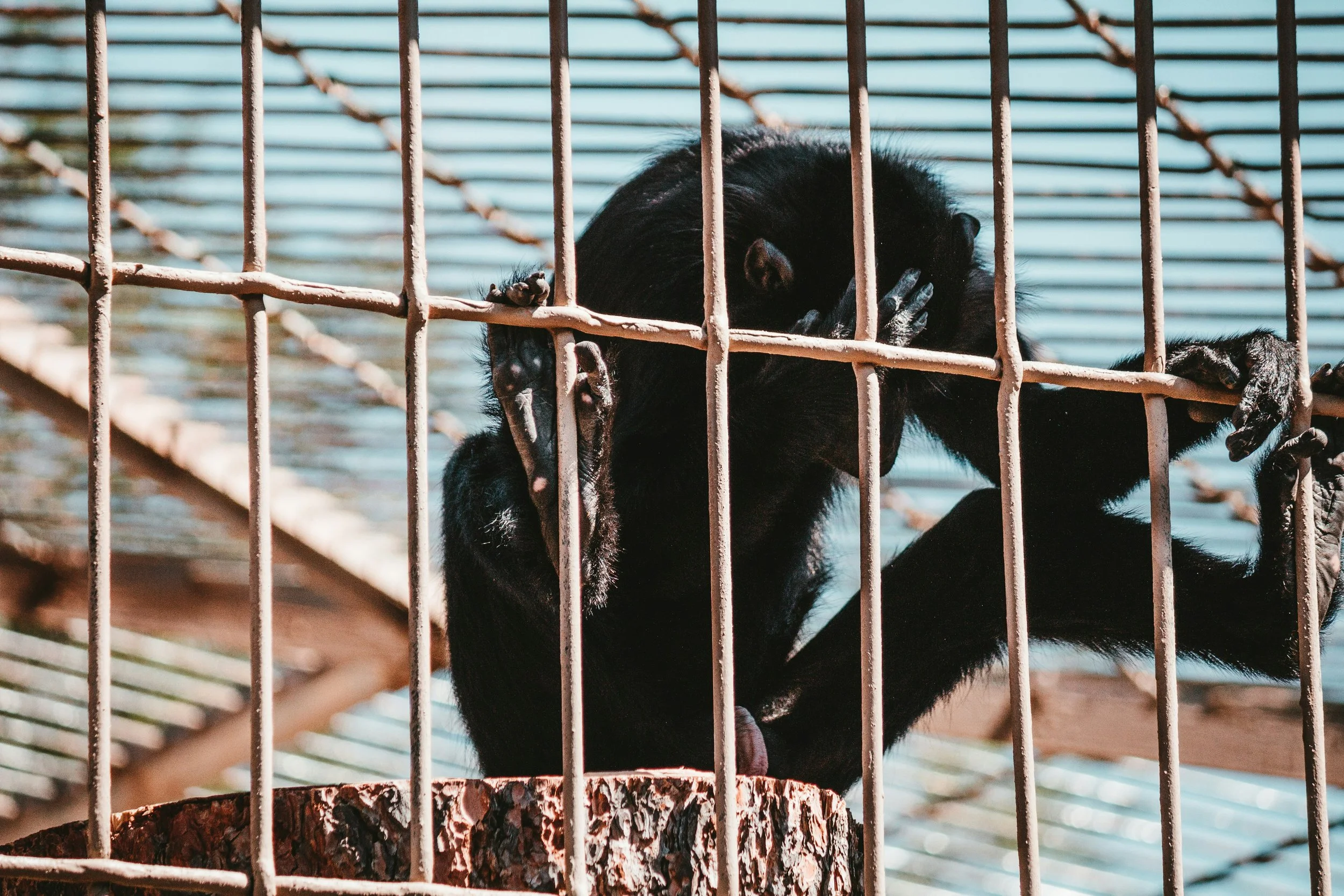
A chimpanzee sits alone behind metal bars inside a zoo enclosure, covering its face and exhibiting behaviors commonly associated with stress and psychological distress in captivity. The image highlights the emotional and cognitive impact of confinement on highly intelligent animals, reinforcing concerns about zoo animal welfare and the ethical implications of keeping primates in restricted environments.
Animals lose the ability to perform the very behaviors that define them in the wild: hunting, navigating, raising offspring. What remains is a diminished version of life, adapted not to ecosystems, but to enclosure.
Brink (2025) describes this condition as zoochosis—a psychological state marked by frustration, stress, and, in severe cases, learned helplessness. The animal stops trying.
Not because it has adapted.
But because resistance no longer changes anything.
Space vs natural habitat
A zoo enclosure may be carefully designed, enriched, even beautiful. It may include vegetation, water features, climbing structures. It may mimic the appearance of a natural habitat.
But it is still a simulation.
In the wild, movement is not optional. It is essential. Species like elephants and dolphins traverse vast distances, guided by memory, need, and social bonds. In captivity, these movements collapse into loops—restricted, repetitive, incomplete.
The environment becomes finite.
Predictable.
Controlled.
Even in modern zoos that strive for realism, the scale cannot match the complexity of an ecosystem. National Geographic (n. d.) notes that urban zoos, in particular, face spatial limitations, compounded by noise, pollution, and constant human presence.
And that presence matters.
Sherwen and Hemsworth (2019) describe the “visitor effect”—the impact of human observation on animal behavior. For some species, visitors are neutral. For others, they are a source of stress: unpredictable, loud, visually intrusive. Elevated stress hormones, increased vigilance, reduced rest—these are not rare outcomes.
Animals, in these contexts, are not only confined.
They are watched.
Continuously.
Exploitation vs conservation
And so the ethical question sharpens: are zoos places of protection, or places of use?
Modern institutions emphasize conservation, research, and education. They design enriched environments, implement welfare protocols, and participate in global breeding programs. According to Beer et al. (2023), animal welfare is now a central pillar, incorporating both physical health and psychological well-being.
Yet the structure remains unchanged.
Animals are still displayed.
The line between education and entertainment is not always clear, and perhaps cannot be. A visitor may come for learning, for curiosity, for leisure. The animal, meanwhile, has no choice in the interaction.
Britannica (2026) highlights this tension: while zoos contribute to conservation and research, they are also sites where animals experience higher rates of physical and psychological issues compared to their wild counterparts. Shorter lifespans in certain species, increased disease, behavioral disorders—these are not anomalies, but patterns.
The contradiction persists.
Zoos aim to protect species.
But protection, here, is built on confinement.
Zoos vs alternatives: what are the options?
If zoos stand on contested ground, then the question naturally widens: what exists beyond them?
What forms of conservation do not require confinement, or at least soften its edges?
Among the most discussed alternatives to zoos are wildlife sanctuaries, national parks, and rewilding projects—each offering a different relationship between protection and freedom.
Sanctuaries, as described by Brink (2025), attempt to reverse the damage of captivity rather than justify it. They prioritize space, reduced human interaction, and environments that more closely resemble natural habitats. Many house animals rescued from trafficking, circuses, or inadequate facilities—individuals for whom release into the wild is no longer possible. Here, the goal is not display, but recovery.
National parks and protected reserves, by contrast, operate on a different scale. They aim to preserve ecosystems rather than individuals, allowing species to live and interact within their natural contexts. This approach aligns more directly with the realities of habitat destruction, which Prugh, Hodges, Sinclair, and Brashares (2008) identify as a central driver of biodiversity loss. Their analysis suggests that the quality of the surrounding environment—the “matrix” between habitat patches—often matters more than the size or isolation of protected areas themselves.
In other words, conservation cannot rely solely on isolated spaces.
It must consider the landscape as a whole.
Then there is rewilding—a concept both ecological and philosophical. It seeks not only to protect what remains, but to restore what has been lost: species, processes, connections. It imagines a world where animals are not managed within enclosures, but re-integrated into functioning ecosystems.
Yet each of these alternatives carries limitations.
Sanctuaries cannot house every displaced animal. Protected areas are vulnerable to political and economic pressures. Rewilding requires time, land, and stability—resources that are often scarce.
And so, zoos persist.
What science says: are zoos effective in conservation?
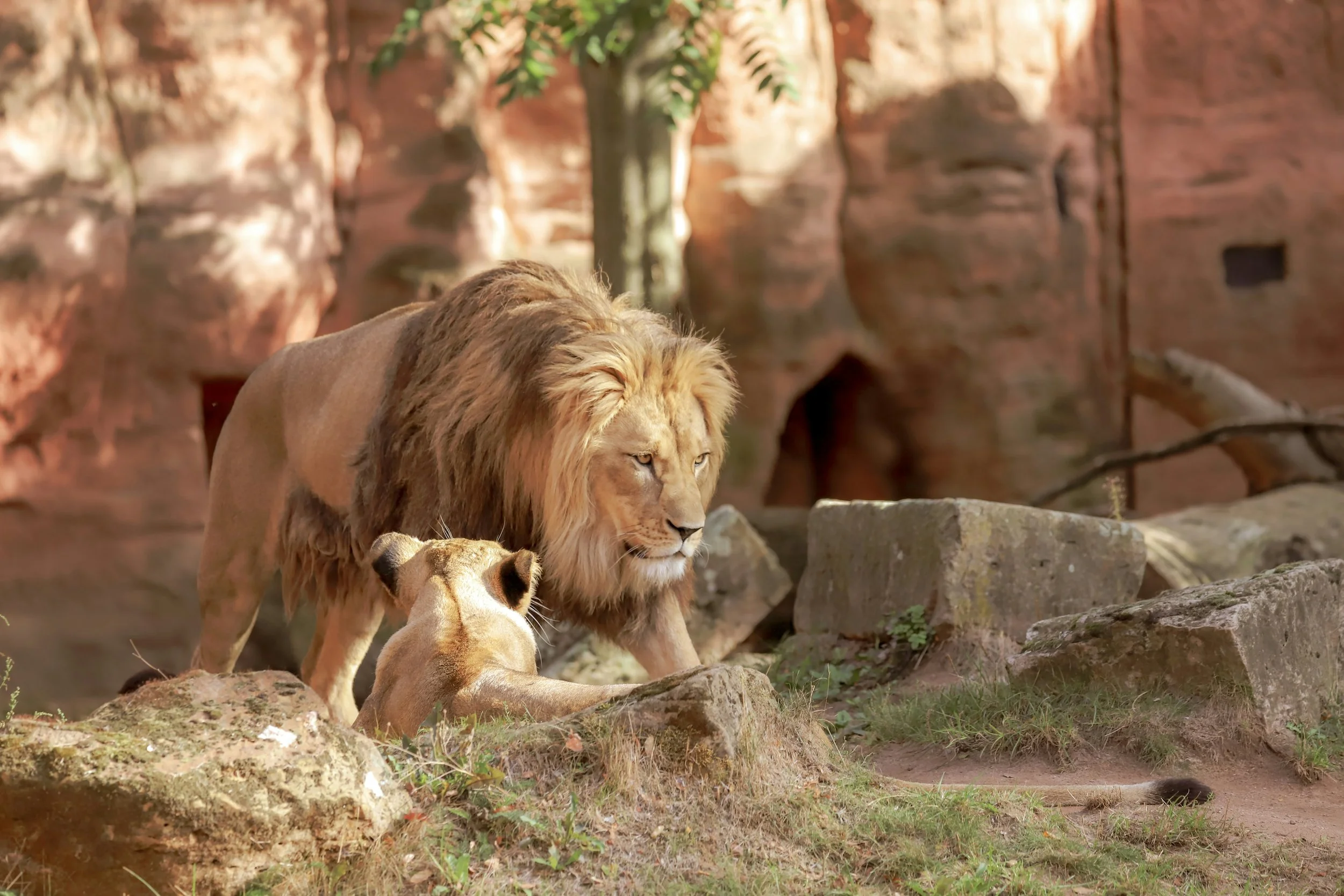
A male and female lion interact within a zoo enclosure designed to mimic aspects of their natural habitat. This image represents the role of zoos in captive breeding programs and species conservation, while also reflecting the limitations of artificial environments compared to life in the wild. It supports the scientific debate on whether zoos are effective in preserving biodiversity and enabling long-term survival of species.
Science does not offer a simple verdict on whether zoos are effective.
Instead, it offers something more uncomfortable: ambiguity.
On one hand, evidence supports the role of zoos in preserving species under immediate threat. Beer, Shrader, Schmidt, and Yates (2023) describe modern zoos as key actors in conservation ex situ, maintaining genetically diverse populations and contributing to research that informs both captive care and wild conservation strategies.
On the other hand, the long-term success of these efforts remains uncertain.
Waples (2007) emphasizes that while captive breeding can sustain populations for decades, the ultimate goal—reestablishing self-sufficient populations in the wild—is far more difficult to achieve. Behavioral adaptation to captivity, genetic changes, and, critically, the continued loss of natural habitats all limit the effectiveness of reintroduction.
Tsui (2023) reinforces this point: although some species have recovered numerically, stability in the wild is not guaranteed. Reintroduction programs face challenges ranging from inadequate habitat to difficulties in training animals to survive independently.
Even the educational impact of zoos is contested. As noted by Britannica (2026), there is no clear evidence that exposure to animals in captivity leads to lasting pro-conservation behavior among visitors.
What emerges, then, is a pattern:
Zoos can prevent extinction in the short term.
They struggle to restore life in the long term.
This distinction matters.
Because conservation is not only about keeping species alive, it is about ensuring they can exist, persist, and evolve within their natural environments.
And on that measure, the success of zoos remains partial.
The future of zoos: evolution or extinction?
If zoos are to remain, they will not do so unchanged.
Already, a shift is underway—from exhibition to what many institutions now call a “conservation-first” model. This transformation emphasizes animal welfare, scientific research, and active participation in global conservation networks.
Beer et al. (2023) describe a growing focus on enriched environments, behavioral monitoring, and species-specific care—efforts aimed at addressing the psychological and physical needs of animals more holistically. Technology, too, is beginning to play a role, enabling less invasive monitoring and new forms of public education.
Yet reform raises deeper questions.
Can captivity ever be fully ethical, no matter how advanced the enclosure?
Can a simulated environment truly replace the complexity of the wild?
Or will zoos, despite their evolution, remain constrained by the very structure that defines them?
At the same time, broader forces shape their future. As Spash (2022) argues, conservation itself is increasingly entangled with economic systems that commodify nature, turning ecosystems into measurable assets. Within this framework, zoos risk becoming part of a larger paradox—protecting biodiversity while operating within systems that contribute to its decline.
The path forward is uncertain.
Some zoos may continue to evolve, aligning more closely with sanctuaries and conservation centers. Others may struggle to justify their existence as ethical standards rise and alternatives expand.
What is clear is this:
The future of zoos will depend not only on what they do, but on what the world demands of them.
Conclusion
So—are zoos still necessary?
The answer resists simplicity.
Zoos have evolved from symbols of power into institutions of science and conservation. They have helped prevent the extinction of certain species, contributed to research, and brought millions of people into contact with the living world. In a time of accelerating biodiversity loss, these roles carry weight.
And yet, the cost is undeniable.
Captivity alters behavior, reshapes minds, and limits lives. The ethical tension between species survival and individual welfare remains unresolved, woven into the very structure of zoos themselves.
Science offers no final judgment, only a balance of outcomes. Zoos can preserve life, but not always restore it. They can educate, but not always transform.
They can protect, but not without consequence.
References
National Geographic. (n. d.). Zoo. https://education.nationalgeographic.org/resource/zoo/
Parks, S. (2025). The Man Who Invented the Modern Zoo Tested Out His Ideas on People First. Smithsonian magazine.https://www.smithsonianmag.com/history/the-man-who-invented-the-modern-zoo-tested-out-his-ideas-on-people-first-180986839/
Beer, H. N., Shrader, T. C., Schmidt, T. B., & Yates, D. T. (2023). The Evolution of Zoos as Conservation Institutions: A Summary of the Transition from Menageries to Zoological Gardens and Parallel Improvement of Mammalian Welfare Management. J. Zool. Bot. Gard. 2023, 4(4), 648-664. DOI: https://doi.org/10.3390/jzbg4040046
Britannica. (2026). Zoos. Should Zoos Exist? https://www.britannica.com/procon/zoos-debate
Waples, R. S. (2007). Captive Breeding and the Evolutionarily Significant Unit. Editor(s): Simon Asher Levin, Encyclopedia of Biodiversity. Elsevier, Pages 1-7, ISBN 9780122268656. DOI: https://doi.org/10.1016/B978-012226865-6/00495-5
Pipes, B. L., & Gonzalez Moreno, P. J. (2024). Captive Breeding and the Evolutionarily Significant Unit. Editor(s): Samuel M. Scheiner, Encyclopedia of Biodiversity (Third Edition). Academic Press, Pages 524-530, ISBN 9780323984348. DOI: https://doi.org/10.1016/B978-0-12-822562-2.00410-2
Tsui, S. (2023). Breeding Programs For Endangered Species: Do They Really Help? Earth Org.https://earth.org/breeding-programmes/
Goldstein, H. (2024). How Animal Captivity Affects Mammals’ Brains, Behavior, and Health. World Animal Protection. https://www.worldanimalprotection.us/latest/blogs/heres-how-captivity-affects-mammals-brains/
Sherwen S. L., & Hemsworth P. H. (2019). The Visitor Effect on Zoo Animals: Implications and Opportunities for Zoo Animal Welfare. Animals (Basel). Jun 17;9(6):366. doi: 10.3390/ani9060366. PMID: 31212968; PMCID: PMC6617010.
Brink, B. (2025). The Psychological Trauma Animals in Cages Endure. The San Diego Animal Sanctuary. https://www.lionstigersandbears.org/the-psychological-trauma-animals-in-cages-endure/
Prugh, L. R., Hodges, K. E., Sinclair, A. R. E., & Brashares, J.S. (2008). Effect of habitat area and isolation on fragmented animal populations. Proc. Natl. Acad. Sci. U.S.A. 105 (52) 20770-20775. DOI: https://doi.org/10.1073/pnas.0806080105.
Spash, C. L. (2022). Conservation in conflict: Corporations, capitalism and sustainable development. Biological Conservation, Volume 269, 109528, ISSN 0006-3207. DOI: https://doi.org/10.1016/j.biocon.2022.109528.