Ecocide: the world’s deadliest crime no one prosecutes

An offshore drilling rig illuminated against a fiery sunset, representing the environmental risks of fossil fuel extraction—from ocean contamination to climate disruption—central themes in global efforts to criminalize ecocide under international law.
A storm gathering in international law
In the quiet corridors of international law, a storm has been gathering. It is the kind of storm that moves slowly, almost imperceptibly, until its consequences ripple through continents and generations. In February 2024, Karim Khan, the Prosecutor of the International Criminal Court (ICC), opened a public consultation that asked a deceptively simple question: how should the world hold perpetrators accountable for environmental destruction? Beneath this question trembled a recognition long delayed: that the living world itself—its rivers, forests, soils, and skies—deserves protection not only in principle, but under law.
The origins of ecocide
The idea is neither new nor frivolous. As Sterio (2024) recounts, the term ecocide emerged in public discourse in 1970, when Arthur W. Galston proposed outlawing the mass destruction of ecosystems. During the Vietnam War, the word surfaced again, a moral alarm in response to herbicidal campaigns and chemical warfare that scarred both land and life. Through the 1970s and 1980s, UN forums debated its codification alongside crimes like genocide, yet caution and geopolitical concerns—especially the shadow of nuclear arms—kept the concept from entering international criminal statutes. By 1998, when the Rome Statute of the ICC was drafted, ecocide remained absent, recognized only in a narrow context: environmental harm as a byproduct of war (Sterio, 2024).

Aircraft sweep low over a forest, releasing the orange chemical mist of Agent Orange—an act that stripped landscapes bare and helped give birth to the very word “ecocide,” as scientists and jurists grappled with the war’s environmental wounds. © Veterans Guardian.
Yet the world outside these statutes continued to shift. Minkova (2024) warns of the uncomfortable truth: the ecosystems on which humans depend are collapsing in ways that the narrow confines of traditional law cannot fully address. The anthropocentric nature of existing international crimes—genocide, crimes against humanity, crimes of aggression, and war crimes—prioritizes human victims, leaving the planet itself vulnerable. De Hemptinne and Prosperi (2024) argue that while some reinterpretation of existing laws is possible—war crimes, for instance, could include attacks on the environment—the thresholds are restrictive, the standards rigid. Proof must show that damage is “extensive, lasting, and severe,” or that actions were intentional, material, and disproportionate (De Hemptinne, 2024). Such standards are poorly suited to the slow, creeping devastation wrought by deforestation, illegal mining, or industrial pollution in times of peace.
The legal imagination must stretch further. De Hemptinne proposes a fully ecocentric crime of ecocide, a law that recognizes the planet’s intrinsic value, whether in war or peace. This law would measure harm not by human-centric suffering alone but by the seriousness of the environmental disruption itself. It would consider acts “wanton,” those carried out with reckless disregard for their ecological consequences, even when cloaked in the language of economic or social development (Sterio, 2024; Minkova, 2024). Corporations, not just individuals, could be held accountable, reflecting the reality that much contemporary environmental harm stems from organized industrial activity rather than the misdeeds of solitary actors.
Global momentum for recognition
The momentum is building. In 2024, three Pacific island nations—Vanuatu, Fiji, and Samoa—formally petitioned the ICC to recognize ecocide as a fifth international crime, joining genocide, crimes against humanity, war crimes, and aggression (Calle, 2024). Their plea is rooted in survival; these nations, perched precariously amid rising seas and fragile ecosystems, have no time for legal delays. The Stop Ecocide Foundation, an international civil society network, has defined ecocide as illegal or reckless acts committed with knowledge that they are likely to cause severe, widespread, or long-lasting environmental damage—a definition that these island states now leverage to plead for urgent recognition (Sterio, 2024; UCLA School of Law, n.d.).
Public support mirrors political initiatives. The 2024 Global Commons survey, covering G20 countries, found that 72% of respondents favor criminalizing activities that cause substantial environmental harm (Calle, 2024). Awareness of planetary fragility is climbing, perhaps most acutely in countries closer to threatened ecosystems, where forests burn and rivers dry, yet it remains uneven across the globe. The stark image of São Paulo’s Pinheiros River, turned an unnatural green from drought and nutrient overload, is a local episode with universal echoes: the visible face of ecological collapse (Calle, 2024).
Overcoming legal barriers to Ecocide justice
And yet, the pathway to justice is complex. Killean and Short (2025) remind us that criminalizing ecocide encounters political, operational, and conceptual barriers. Legal clarity must coexist with flexibility, lest the law be impotent against unforeseen forms of environmental harm. The ICC can only prosecute natural persons, not corporations—those very agents that most often catalyze ecological devastation. And the slow, diffuse nature of environmental damage challenges the urgency and visibility that traditional international crimes demand.
Ecocide as a moral and legal principle
Despite these barriers, the effort to recognize ecocide carries profound symbolic and practical value. Fleming (2021) notes that codifying ecocide acknowledges that environmental destruction is not a side effect of human activity but a crime in itself, one that can imperil human life and the conditions of civilization. Trejo (2021) reinforces this, highlighting the disproportionate impact of ecological disasters on vulnerable populations, whose rights to life, health, and habitation are entwined with the health of the planet. To criminalize ecocide is to assert a principle: the Earth, in its totality, is a stakeholder in justice.
Ecocide law: addressing complexity with humility and foresight
In this emerging legal and moral landscape, the challenge is not only to define ecocide, but to integrate that definition with humility and foresight. De Hemptinne (2024) and Minkova (2024) both caution against adopting legal formulas that merely quantify environmental harm against economic benefit, for such calculations can mask the very inequities and destruction the law seeks to prevent. The crime of ecocide, if properly codified, must account for the interwoven complexity of ecosystems, societies, and economies; it must recognize that harm is rarely isolated, rarely fleeting, and often inseparable from the structures that produced it.
Thus, we stand at the edge of a potentially transformative moment in law and ethics. From the consultations of the ICC to the advocacy of island nations, from civil society panels to public opinion, there is a shared insistence: that ecocide is no longer invisible, no longer permissible. Its recognition as a crime could shift the arc of accountability, aligning law not only with human justice, but with ecological justice, and demanding that the living world itself be seen as a subject of care, protection, and reverence.
Early illustrations: Vietnam
The Vietnam War offers one of the earliest modern illustrations. According to the Institute of Medicine (US) Committee to Review the Health Effects in Vietnam Veterans of Exposure to Herbicides (1994), the U.S. military sprayed 17.6 million gallons of herbicides over 3.6 million acres, primarily through Operation Ranch Hand. Among these chemicals was Agent Orange, contaminated with TCDD, one of the most toxic substances known. What began as a military strategy—to strip forests, expose enemy positions, and destroy crops—soon became an environmental and human catastrophe. Dioxin persisted in soils and tissues, causing cloracné, liver toxicity, reproductive effects, and malformations observed in laboratory animals. Decades of study in exposed workers and Vietnamese communities revealed a prolonged, generational impact. The forests and rivers were not merely altered—they were poisoned, and with them, the lives of those who depended on them.
Industrial disasters across Europe
Baia Mare, Romania
In Europe, the Baia Mare disaster, documented by Jakubowicz, Wieloch, Renard, Musiałek, and Ouabel (2022), exemplifies the vulnerability of human and natural systems to industrial negligence. On January 30, 2000, a tailings dam failed, releasing approximately 100,000 cubic meters of cyanide- and metal-laden waste into rivers flowing toward the Black Sea. The ecological toll was immediate: 80% of Tisza river fish perished, plankton vanished, and metal concentrations exceeded safe thresholds. Local economies collapsed as fishing and tourism ceased. Despite European Union reforms introducing the “polluter pays” principle, enforcement lagged. Even twenty years later, soils and crops retain toxic metals, and attempts to ban cyanide in mining repeatedly faltered under economic and political pressures.
Ajka “Red Mud,” Hungary
Hungary’s Ajka “red mud” incident of 2010, studied by Winkler, Bidló, Bolodár-Varga, Erdő, and Horváth (2018), left nearly a million cubic meters of highly alkaline sludge over farmland, pastures, and forests. The red mud, containing cadmium, nickel, and chromium, penetrated the soil, altering texture and porosity, and reshaping microfaunal communities. Sensitive organisms disappeared, leaving simplified assemblages dominated by resistant species. Even as salinity stress lessened, metals and trace contaminants persist. This disaster demonstrates that soil itself bears memory; ecological recovery is slow, fragile, and uncertain.
Doñana, Spain
In Spain, the Doñana wetlands suffered a similarly violent disruption. Pain, Sánchez, and Meharg (1998) recount how, on April 25, 1998, a mine dike at Los Frailes burst, releasing five million cubic meters of acidic pyrite sludge. Rich in arsenic, lead, and zinc, the lye cascaded down the Agrio and Guadiamar rivers, lowering pH drastically and killing fish and invertebrates en masse. Critical breeding grounds for endangered species—the cerceta pardilla, the malvasía duck, the Iberian imperial eagle—were threatened. Sediments remained toxic long after the initial spill, highlighting the long-term challenge of remediation and the necessity of clear environmental objectives in cleanup efforts.
Chronic ecocide in resource extraction
The Niger Delta, Nigeria
The Niger Delta presents a slower, chronic form of ecocide. Ordinioha and Brisibe (2013) detail annual crude oil spills averaging 240,000 barrels, infiltrating water, soil, crops, and aquifers. Hydrocarbons and heavy metals accumulate in human and animal tissues, raising cancer risks, impairing nutrition, and undermining child development. Local communities endure daily exposure with little medical support, illustrating how industrial negligence translates into intergenerational human suffering.
Belo Monte Dam, Brazil
Finally, in the Amazon, the Belo Monte dam on the Xingu River has altered floodplain ecosystems in ways deeply recorded by local communities. Quaresma et al. (2025) document the creation of an independent monitoring system, MATI-VGX, by Indigenous and riverine populations. Their observations reveal disrupted seed dispersal, the appearance of leafcutter ants, and the decline of species adapted to seasonal floods. The diversion of 70–80% of the river’s flow has interrupted the natural rhythms that sustain both ecological and cultural continuity, demonstrating that human engineering can sever the pulse of life itself.
These events, drawn from multiple continents and decades, show ecocide as a lived reality. Rivers, soils, forests, and the human bodies intertwined with them bear the evidence. This is not an abstraction. It is tangible, persistent, and inequitable: some profit, others pay the price.
War as ecocide: Ukraine
In Ukraine, war itself has become an agent of environmental destruction. Leal Filho et al. (2024) detail how protected natural areas—crucial for biodiversity, soil stability, and water regulation—have suffered profound damage. Explosions, fires, heavy vehicles, and landmines have scarred landscapes, particularly in Chornobyl REBR, Desniansko-Starohutskyi NNP, Holosiivskyi NNP, and Hetmanskyi NNP. Nearly 14% of Chornobyl’s protected land burned, while heavy metals and residues from explosives now infiltrate soils, disrupting ecosystems long after active conflict. Access for emergency response was blocked, allowing fires to spread uncontrolled. Here, war and ecological collapse are inseparable, and the cost is borne by both humans and nonhuman life.
Resource extraction and social violence: Venezuela
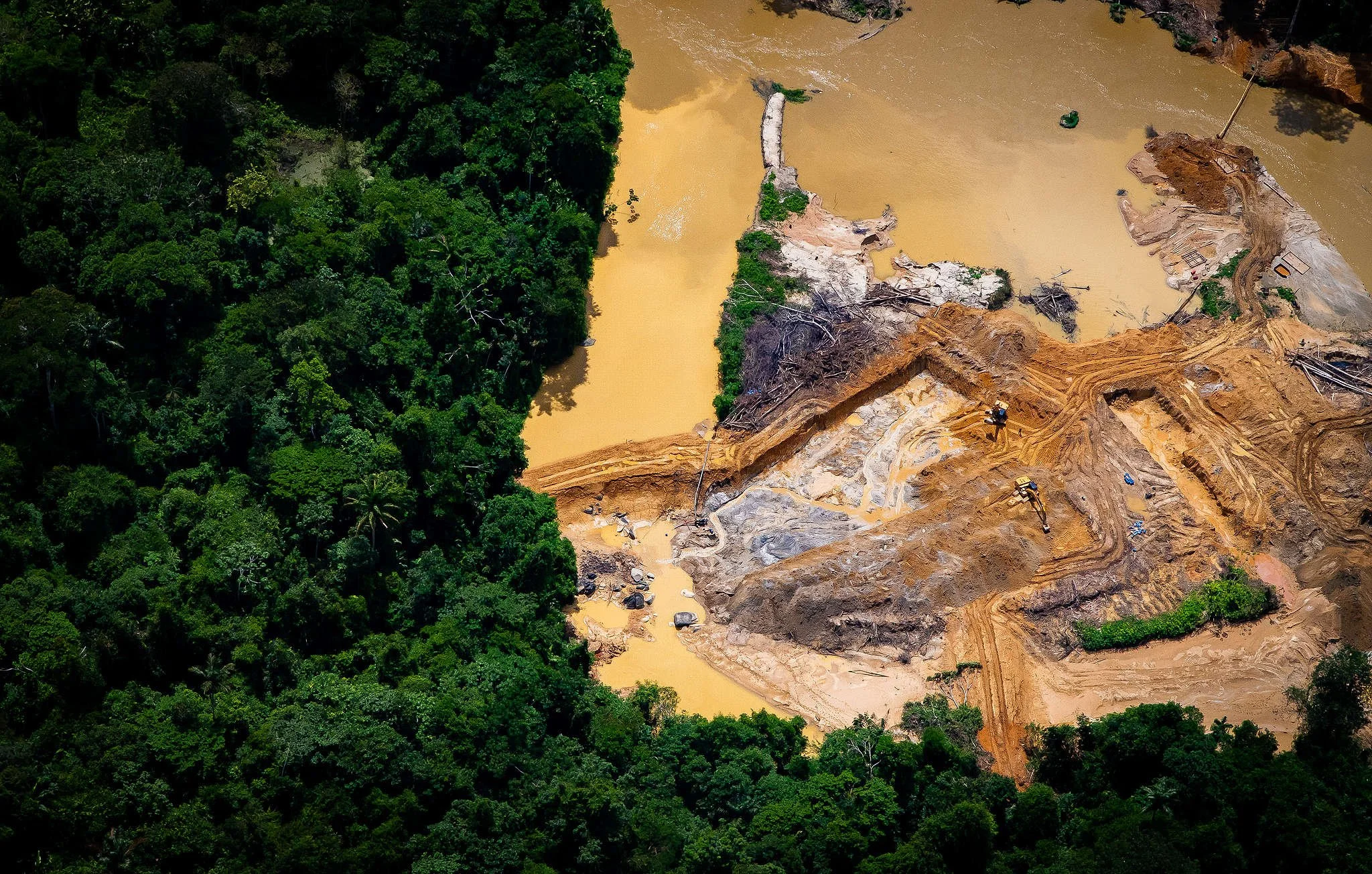
On December 5, 2022, a joint Greenpeace–ISA overflight revealed four excavators advancing on a recently identified illegal road inside the Yanomami Indigenous Territory, one of Brazil’s most gravely endangered Indigenous lands. © Valentina Ricardo. Greenpeace.
Further south, Venezuela’s Arco Minero region reveals how resource extraction intertwines ecocide with social violence. According to the International Crisis Group (2025), illegal gold mining in Bolívar and Amazonas has accelerated deforestation, mercury contamination, and habitat destruction. Military authorities often collude with armed groups, turning territories into contested zones where Indigenous communities are displaced, coerced, or forced into labor. The resulting environmental devastation is mirrored by social dislocation: communities abandon traditional agriculture, rivers fill with toxins, and the rainforest itself becomes a landscape of conflict and extraction. International demand for gold sustains this system, revealing how global markets perpetuate ecological harm at a local scale.
The long-term collapse: Aral Sea
Half a world away, the Aral Sea exemplifies the consequences of long-term, human-driven ecological mismanagement. Wang et al. (2020) and Abbott (2025) document the sea’s dramatic decline. Once the fourth-largest lake in the world, the Aral Sea lost over 90% of its surface by the early 2000s, its fisheries collapsed, and local communities suffered extreme economic and social disruption. Water diversions for cotton, rice, and alfalfa during the Soviet era reduced inflows by roughly 75%, triggering soil salinization, toxic dust storms, and microclimate changes. Crop yields fell; human health deteriorated, with cancer rates 50–60% higher than surrounding areas and child mortality rising from 45 to 72 per 1,000 live births. Populations migrated in the hundreds of thousands, and towns like Moynaq and Aralsk transitioned from bustling ports to desert settlements dependent on disaster tourism. The Aral Sea stands as a stark testament: ecocide can unfold gradually, yet its consequences ripple through generations.
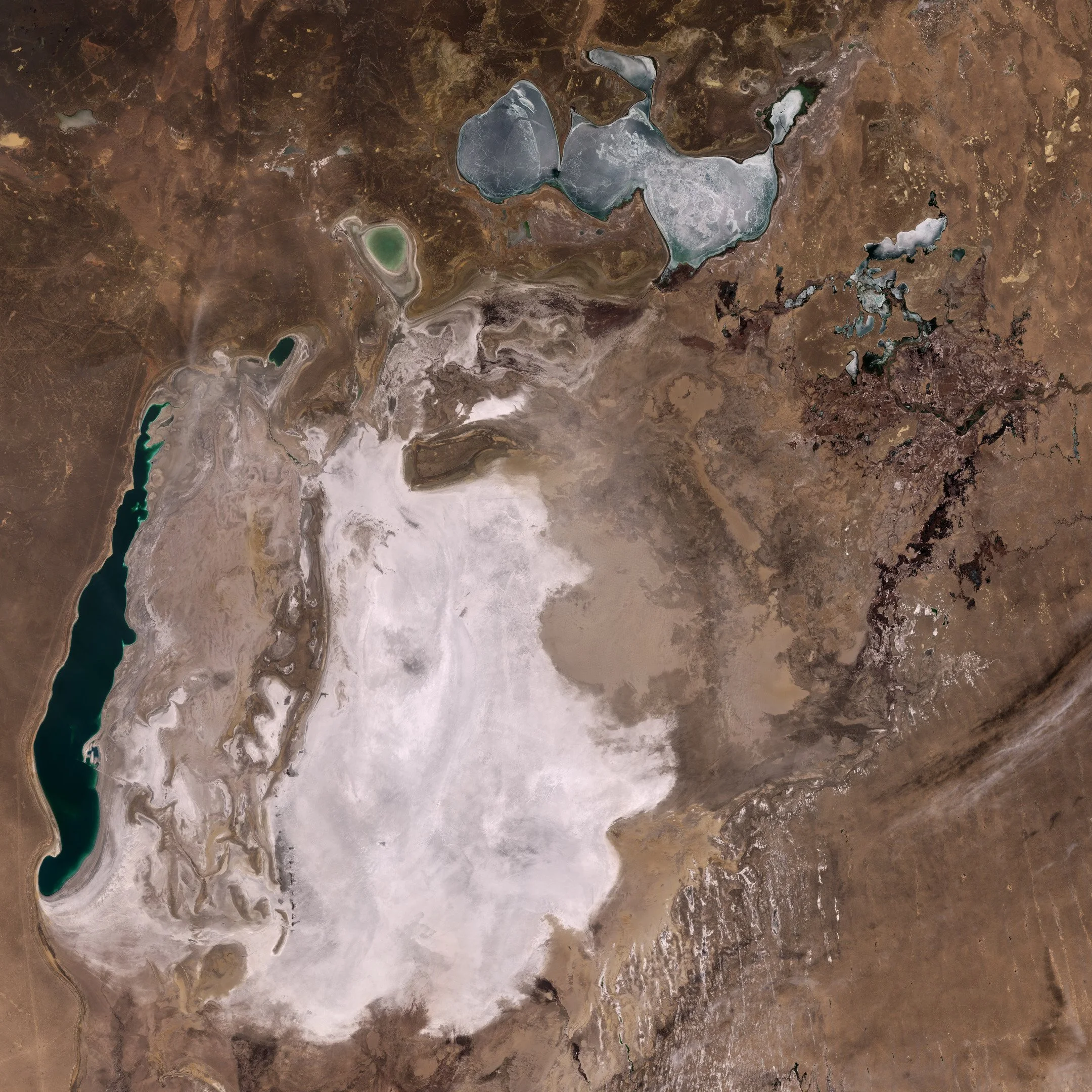
Satellite view revealing the near-total disappearance of the Aral Sea, with salt deserts and scattered water remnants replacing what was once a vast lake. The image highlights the long-term environmental devastation caused by large-scale water mismanagement and unsustainable resource use. © Copernicus Sentinel data (2025). The European Space Agency.
Ecocide is real, daily, and unequal
These cases illustrate a sobering truth: ecocide is neither abstract nor distant. It is daily, measurable, and often invisible to those who profit from it. It is simultaneously a crime against ecosystems and a crime against human continuity.
Accounting for destruction: the debate over ecocide law
Arguments for legally recognizing ecocide are compelling. It offers protection for critical ecosystems, establishes accountability for large-scale environmental harm, and provides justice for communities historically exposed to toxic hazards. Critics warn of regulatory overreach, economic risk, and challenges in defining intent. Yet the evidence is undeniable: persistent contamination, chronic health crises, and ecosystem collapse demonstrate a deliberate or reckless disregard for life that demands response.
The process of recognition is underway. Proposals to include ecocide in the Rome Statute of the International Criminal Court envision a system where environmental destruction—particularly when it threatens human survival or ecosystems—is prosecutable under international law. Such recognition transforms justice: not only as retribution, but as acknowledgment of ecological memory, of the intertwined fate of human and nonhuman life.
If the Earth could testify: a trial for ecocide
In imagining a future where the land itself speaks in courtrooms, we may see rivers claiming repair, soils demanding remediation, and forests seeking restitution. Justice becomes an act of memory—an act that honors continuity, acknowledging that every species lost, every poisoned river, and every displaced community is a chapter in a shared story of ecological inheritance. Ecocide is not merely a crime against nature; it is a crime against our future.
And when the law finally listens, it may not only punish—it may bear witness. In that witness, we might hear the quiet truth: the crime against Earth is inseparable from the crime against humanity, and the continuity of life itself hangs in the balance. To honor the Earth, we must act with courage and conviction. The time is NOW.
References
Abbott, B. (2025, August 27). Overview of the Aral Sea disaster. Grow the Flow. https://growtheflowutah.org/2025/08/27/overview-of-the-aral-sea-disaster/
Caldwell, G. (2021, August 30). Should environmental harm be an international crime? Here’s what you need to know about ecocide. World Economic Forum. https://www.weforum.org/stories/2021/08/ecocide-environmental-harm-international-crime/
Calle, M. C. (2024, September 25). The ICC discusses the option of treating ecocide as an international crime. France24. https://www.france24.com/es/programas/medio-ambiente/20240925-la-cpi-discute-la-opci%C3%B3n-de-tratar-el-ecocidio-como-un-crimen-internacional
De Hemptinne, J., & Prosperi, L. (2024, May 25). Prosecuting ecocide before the International Criminal Court: Concrete possibility or long-term ambition? (Part 1). Utrecht University. Retrieved from https://www.uu.nl/en/news/prosecuting-ecocide-before-the-international-criminal-court-concrete-possibility-or-long-term
Institute of Medicine (US) Committee to Review the Health Effects in Vietnam Veterans of Exposure to Herbicides. (1994). History of the controversy over the use of herbicides. In Veterans and Agent Orange: Health effects of herbicides used in Vietnam. National Academies Press (US). https://www.ncbi.nlm.nih.gov/books/NBK236351/
International Crisis Group. (2020, July 29). The curse of gold: Mining and violence in Venezuela’s south (Report N°53/Latin America & Caribbean). https://www.crisisgroup.org/latin-america-caribbean/andes/venezuela/b53-curse-gold-mining-and-violence-venezuelas-south
Jakubowicz, M., Wieloch, W., Musiałek, M., Renard, M., & Ouabel, Y. (2022). The Baia Mare catastrophe: Political and Environmental implications. https://www.researchgate.net/publication/358900891_The_Baia_Mare_catastrophe_Political_and_Environmental_implications
Killean, R., & Short, D. (2025). A critical defence of the crime of ecocide. Environmental Politics, 1–21. DOI: https://doi.org/10.1080/09644016.2025.2492441
Leal Filho, W., Fedoruk, M., Eustachio, J. H. P. P., Splodytel, A., Smaliychuk, A., & Szynkowska-Jóźwik, M. I. (2024). The environment as the first victim: The impacts of the war on the preservation areas in Ukraine. Journal of Environmental Management, 364, 121399. DOI: https://doi.org/10.1016/j.jenvman.2024.121399
Minkova, L. G. (2024). Ecocide, sustainable development and critical environmental law insights. Journal of International Criminal Justice, 22(1), 81–97. DOI: https://doi.org/10.1093/jicj/mqae006
Ordinioha, B., & Brisibe, S. (2013). The human health implications of crude oil spills in the Niger delta, Nigeria: An interpretation of published studies. Nigerian Medical Journal, 54(1), 10–16. DOI: https://doi.org/10.4103/0300-1652.108887
Pain, D. J., Sánchez, A., & Meharg, A. A. (1998). The Doñana ecological disaster: Contamination of a world heritage estuarine marsh ecosystem with acidified pyrite mine waste. Science of The Total Environment, 222(1–2), 45–54. DOI: https://doi.org/10.1016/S0048-9697(98)00290-3
Quaresma, A., Zuquim, G., Demarchi, L. O., Ribas, C. C., Wittmann, F., Assunção, A. M., Carneiro, C. C., Ferreira, P. P., Juruna, J. J. P., et al. (2025). Belo Monte Dam impacts: Protagonism of local people in research and monitoring reveals ecosystem service decay in Amazonian flooded vegetation. Perspectives in Ecology and Conservation, 23(1), 39–50. DOI: https://doi.org/10.1016/j.pecon.2025.02.001
Sterio, M. (2024). Crimes against the environment, ecocide, and the International Criminal Court. Case Western Reserve Journal of International Law, 56(1), 223–257. https://scholarlycommons.law.case.edu/jil/vol56/iss1/12
Trejo, M. (2021, March 4). Ecocide: Justice for the victims of environmental crime. The Conversation. https://theconversation.com/ecocidio-justicia-para-las-victimas-del-crimen-ambiental-152260
UCLA Promise Institute for Human Rights. (n.d.). The crime of ecocide. Retrieved from https://promiseinstitute.law.ucla.edu/project/the-crime-of-ecocide/
Wang, X., Chen, Y., Li, Z., Fang, G., Wang, F., & Liu, H. (2020). The impact of climate change and human activities on the Aral Sea Basin over the past 50 years. Atmospheric Research, 245, 105125. DOI: https://doi.org/10.1016/j.atmosres.2020.105125
Winkler, D., Bidló, A., Bolodár-Varga, B., Erdő, Á., & Horváth, A. (2018). Long-term ecological effects of the red mud disaster in Hungary: Regeneration of red mud flooded areas in a contaminated industrial region. Science of The Total Environment, 644, 1292–1303. DOI: https://doi.org/10.1016/j.scitotenv.2018.07.059